Supplements: Evidence, Labels, Interactions & Safer Choices
Learn how to assess supplement claims, read doses and ingredients, check interactions, and decide when testing or professional advice is more useful.
Sources for this guide are listed below. No individual clinical reviewer is credited for this article; use a qualified professional for personal medical decisions.
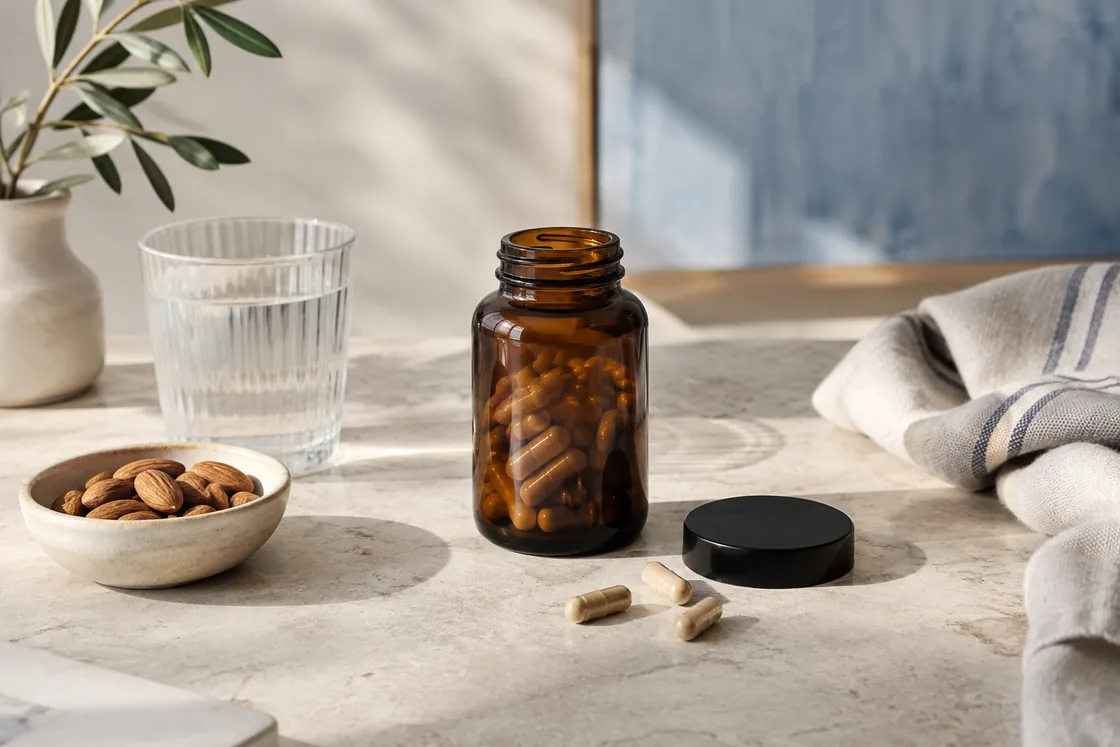
A supplement is useful only when its purpose, evidence, dose and risks make sense for you. “Natural” does not mean risk-free. Check the full label and interactions, and avoid treating fatigue or another symptom as proof that you need a particular nutrient.
Start with the reason, not the marketing claim
Are you correcting a confirmed deficiency, following advice for a specific life stage, or responding to an advertisement? Those are different decisions. Ask what benefit the exact ingredient and dose have been shown to provide, in whom, and over what time. General claims about energy, immunity or cortisol do not establish that a product will solve your symptom.
Read serving size before comparing doses
A label may state the amount per capsule or per serving, and a serving may contain several capsules. Check every active ingredient and any other products you already take so you do not unintentionally double up. Keep the exact product name and label for a pharmacist or clinician; “a multivitamin” may not provide enough detail.
Check medicines and other interactions
Supplements can interact with medicines, other supplements and planned procedures. Tell the healthcare team what you take, including occasional products and powders. Pregnancy, breastfeeding, chronic illness and preparation for surgery can change what is appropriate. Do not replace prescribed treatment with a supplement or assume that more of a nutrient is better.
What independent testing does and does not show
Quality checks can help assess whether a product contains what its label says and meets certain contaminant standards. They do not automatically prove that it provides the claimed health benefit. Look for a named, verifiable testing program rather than vague language such as “lab approved.” Read what was actually tested.
Magnesium, ashwagandha and fatigue claims
These products are often marketed for sleep, stress or energy, but the right decision depends on the specific preparation, evidence and individual risks. A general symptom does not identify a magnesium deficiency, and a stress claim does not prove a cortisol disorder. Bring the exact product to a pharmacist or clinician before combining it with medicines or using it to treat persistent symptoms.
Make the decision easy to review
Write down why you are considering the product, the intended dose, the cost and how you will judge whether it is worthwhile. If advised to use it, clarify duration and follow-up. For unexplained ongoing fatigue, a healthcare assessment may be more useful than cycling through products.
Use a claim checklist before buying
Identify the exact ingredient, dose and intended benefit. Ask whether the evidence applies to people like you and to that product or only to a different formulation. Be cautious when a promise relies on a testimonial, a general wellness score or urgency to purchase. A supplement label is not proof that a symptom has been investigated or that a deficiency is present.
Keep a record that a pharmacist can review
List the product name, ingredient amounts, serving size, frequency and any other products containing the same ingredient. Bring the labels with your prescribed and non-prescribed medicines. Ask about interactions and whether you are duplicating a dose. Do not replace prescribed treatment or stop a medicine because a marketing claim describes a product as natural.
Common questions
Can supplements replace a balanced diet?
They do not replace the range of nutrients and other components provided by food. Some people have specific needs that should be addressed individually.
Does a quality seal prove a supplement works?
No. A quality program may assess ingredients or contaminants, not clinical effectiveness for the advertised claim.
Sources and further reading
This is general educational information, not a diagnosis or personalized treatment plan. Device information is identified separately from independent health guidance.