TSH is made by your pituitary gland,
a small gland in your brain. It tells your thyroid how much thyroid hormone to make.
 Written and medically reviewed by Dr. Lena Hoffmann, Endocrinology
Looking up TSH levels normal range usually starts with a number on a lab report and a small flag next to it. TSH stands for thyroid-stimulating hormone. It is often the first test a doctor uses to check how your thyroid is working.
TSH levels normal range: typical values and units
a small gland in your brain. It tells your thyroid how much thyroid hormone to make.
When thyroid hormone is low, the pituitary usually makes more TSH. When thyroid hormone is high, it makes little or none.
A low TSH can point to an overactive thyroid, or to too much thyroid medicine.
Your thyroid is a small gland in the front of your neck. It makes hormones that help set the pace of many processes in your body. Your pituitary gland keeps an eye on how much thyroid hormone is in your blood and adjusts TSH to match.
Think of TSH as the pituitary’s voice. If your thyroid is not making enough hormone, the pituitary speaks louder, and TSH goes up. If your thyroid is making too much, the pituitary goes quiet, and TSH goes down. That is why a high TSH usually means an underactive thyroid, not an overactive one. It catches many people out.
MedlinePlus explains that a TSH level that is too high or too low may point to a thyroid problem, but it cannot show what is causing it. That is the job of the follow-up tests.
Doctors use TSH to check for an underactive thyroid (hypothyroidism) or an overactive thyroid (hyperthyroidism). They also use it to check the dose for people who take thyroid hormone tablets, to follow up after treatment for an overactive thyroid, and as part of the work-up for thyroid lumps. The NHS lists TSH among the common blood tests used to check thyroid function.
The British Thyroid Foundation notes that many labs work in a cascade. If TSH is above the reference range, they go on to measure T4. If TSH is below it, they measure T4 and T3.
MedlinePlus says a higher-than-normal TSH is most often due to an underactive thyroid gland. Hashimoto’s disease is one cause. The NHS says Hashimoto’s, an autoimmune condition in which the immune system attacks the thyroid, is the main cause of an underactive thyroid in the UK. It is most common in women and usually starts between the ages of 30 and 50.
The British Thyroid Foundation describes two common patterns:
The NHS lists symptoms of an underactive thyroid that include feeling very tired, feeling colder than usual, weight gain, constipation, difficulty concentrating, low mood, dry skin, dry hair or hair loss, a croaky voice, and irregular or heavy periods.
These symptoms are often mild. The NHS says they usually develop slowly and get worse over time. MedlinePlus adds that an underactive thyroid often develops so slowly that symptoms may go unnoticed for months or years. Many of these symptoms also have other causes, which is exactly why a blood test helps.
For the full list of symptoms on both sides, and a short questionnaire to take to your doctor, see the thyroid symptoms test.
MedlinePlus says a lower-than-normal TSH may be due to an overactive thyroid. It lists causes such as Graves’ disease, toxic nodular or multinodular goitre, too much iodine (for example from iodine contrast used in CT scans), and taking too much thyroid hormone medicine or supplements that contain thyroid hormone.
The NHS says about 4 in every 5 people with an overactive thyroid have Graves’ disease, and that an overactive thyroid is about 10 times more common in women than men.
The British Thyroid Foundation adds two more patterns:
This page explains what TSH measures, the ranges that trusted sources publish, and what a high or low result can point to. It also covers the things that can shift your result, such as medicines, supplements, illness and pregnancy.
One thing to keep in mind from the start: labs use slightly different ranges and units. Your lab report shows the range your lab uses, and that is the one to compare your number with.
Here are the ranges two trusted sources publish for adults. They are a guide, not a verdict. Your lab report shows the range your lab uses, and your doctor reads your number against that range, together with your symptoms and other results.
| Test | Typical adult range | Units | Source |
|---|---|---|---|
| TSH | 0.4 to 4.0 | mU/l (milliunits per litre) | British Thyroid Foundation |
| TSH | 0.4 to 4.8 | µU/mL (microunits per millilitre) | MedlinePlus |
| Free T4 (FT4) | 9.0 to 25.0 | pmol/l (picomoles per litre) | British Thyroid Foundation |
| Free T3 (FT3) | 3.5 to 7.8 | pmol/l (picomoles per litre) | British Thyroid Foundation |
The British Thyroid Foundation says these ranges are only a guide and will vary by laboratory. MedlinePlus notes that some labs use a higher upper limit for older people, even as high as 7 µU/mL, and that the normal range is different in pregnancy. Children have their own ranges.
The NHS lists symptoms of an overactive thyroid that include nervousness, anxiety and irritability, mood swings, trouble sleeping, ongoing tiredness and weakness, sensitivity to heat, a swelling in the neck (goitre), a fast or irregular heartbeat, tremor and weight loss.
MedlinePlus notes that older adults with an overactive thyroid may have different symptoms, such as loss of appetite or withdrawing from others. These can be mistaken for depression or dementia.
If you are noticing symptoms but have not had a test yet, the thyroid symptoms test helps you decide what to raise.
A TSH number is a snapshot. Several things can move it without your thyroid changing. The sources below list the main ones.
Routine testing is a decision for you and your doctor. The British Thyroid Foundation suggests asking about a thyroid test if any of these apply to you:
TSH varies through the day, and MedlinePlus suggests early morning is best. If you have repeat tests, try to keep the time of day similar.
Write down every medicine and supplement, especially biotin, iodine, steroids, lithium and amiodarone. Hand the list to whoever orders the test. Do not stop anything without their advice.
The NHS says a GP will ask about your symptoms, any family history of thyroid or autoimmune conditions, and any recent pregnancy. Having this written down saves time.
Thyroid care often means repeat tests. The British Thyroid Foundation says that once treatment is stable, people with an underactive thyroid usually need a TSH test about once a year. Keeping every report in one place makes trends easy to see.
The NHS says the usual treatment for an underactive thyroid is levothyroxine, with regular blood tests to check the dose. The British Thyroid Foundation notes symptoms can take several months to improve even when results look right.
ONU does not sell lab tests, and it does not read or interpret your results. That job belongs to the doctor who ordered your test.
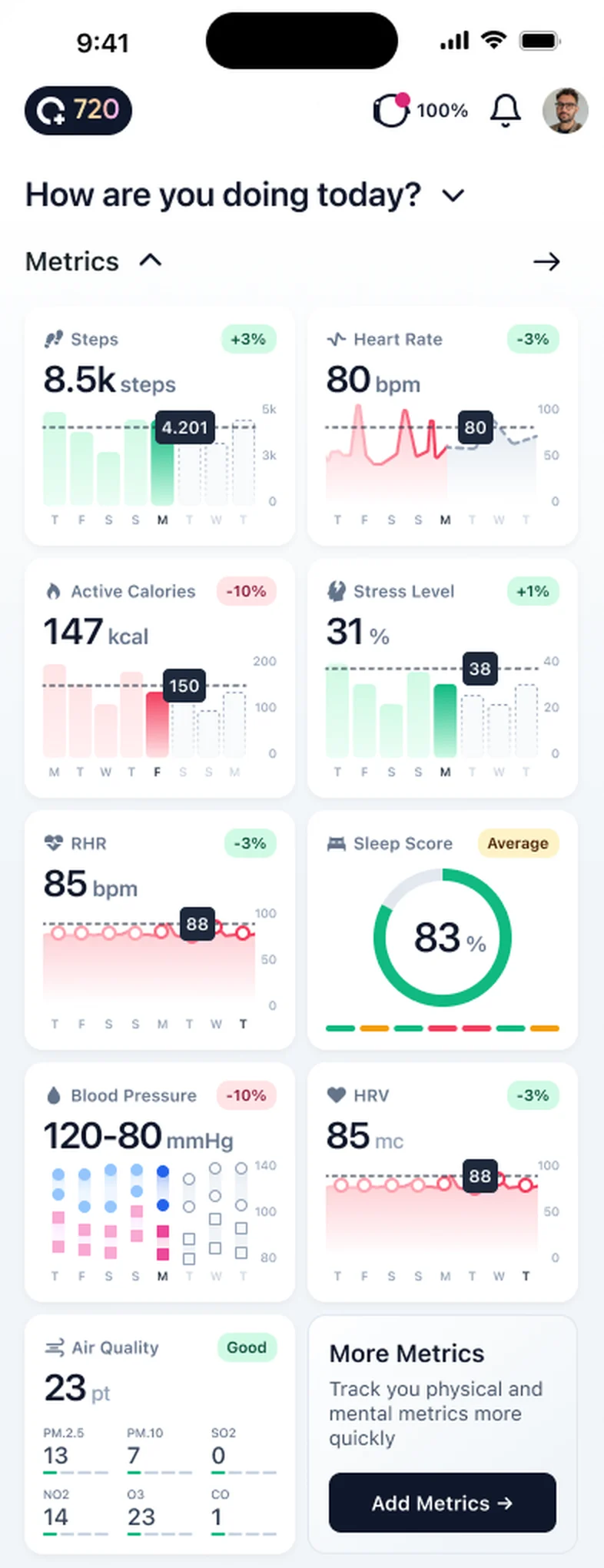
What ONU can do is help you keep things in one place. In the free ONU app on iPhone, you can upload and store your lab reports, including your thyroid results, and see them next to your daily sleep, recovery and activity trends. If you have repeat TSH tests over months or years, that makes it easier to bring the full picture to your next appointment.
If you are not sure whether to ask about your thyroid, try the free thyroid check. It takes a few minutes and ends with a summary you can take to your doctor. For help reading other parts of a report, see blood test results explained.
See your GP or doctor if you think you might have an underactive or overactive thyroid, or if your report shows a TSH outside your lab’s range and nobody has talked it through with you yet. The NHS also says to tell your GP if you have an underactive thyroid and are pregnant or planning a pregnancy, because your dose may need to change.
Some thyroid problems are emergencies. The NHS describes thyroid storm as a sudden and life-threatening flare-up of overactive thyroid symptoms, and myxoedema coma as a rare, life-threatening complication of an underactive thyroid that needs hospital treatment. If you or someone with you is suddenly very unwell, call your local emergency number. See emergency information.
Bring your everyday signals and health information into a clearer picture.