The usual test measures 25(OH)D
MedlinePlus says this is the form that best shows whether you have enough vitamin D.
 Written and medically reviewed by Dr. Lena Hoffmann, Endocrinology
Vitamin D blood test levels can be confusing, because the same result can be written in two different units and labs use different words for it. Most tests measure a form called 25-hydroxyvitamin D, or 25(OH)D, which shows how much vitamin D your body has to work with.
Vitamin D blood test levels: the NIH cut-offs
MedlinePlus says this is the form that best shows whether you have enough vitamin D.
nmol/L and ng/mL. The NIH gives both. Check which one your report uses before comparing numbers.
for bone and overall health. Below 30 nmol/L (12 ng/mL) is too low. Above 125 nmol/L (50 ng/mL) is too high.
Your skin makes vitamin D when sunlight falls on it, and you also get some from food and supplements. MedlinePlus explains that your liver then turns vitamin D into 25-hydroxyvitamin D. This is the form most tests measure.
There is a second test for the active form, called 1,25-dihydroxyvitamin D or calcitriol. MedlinePlus says it is not usually used to check whether you have enough vitamin D. It may be used to monitor kidney problems or to look into abnormal calcium levels. If your report shows both, the 25(OH)D result is the one about your vitamin D status.
Some reports split the result into D2 and D3. MedlinePlus says the two work about the same, and that total vitamin D is the important number to check.
MedlinePlus says a doctor may order the test if you have a condition linked to low vitamin D, such as low bone density or osteomalacia, or symptoms such as bone pain, muscle weakness or fractures. It can also check whether supplements are working, or look for too much vitamin D if you take supplements and have symptoms.
MedlinePlus says a low result may come from not getting enough vitamin D from food or sunlight, from a condition that stops you absorbing it, from kidney or liver disease that affects how your body converts it, or from a medicine.
Over time, low vitamin D can weaken bones. The NHS says rickets in children and osteomalacia in adults are usually caused by low levels of vitamin D or calcium. In adults, the NHS lists symptoms such as swollen, painful wrists; pain in the back, shoulders, ribs, pelvis or legs; changes in the way you walk or tiring easily; difficulty with stairs or getting out of a chair; muscle tingling, cramps or twitching; and breaking bones more easily. In children the main sign is bowed legs.
MedlinePlus lists bone pain, muscle weakness or aches, soft or misshapen bones, and weak bones or fractures as signs of deficiency. Many people with a low level notice nothing at all, which is one reason the NHS gives general supplement advice rather than relying on symptoms.
The NHS and the NIH give slightly different daily amounts, because they serve different populations. Both are shown here so you can see where each figure comes from.
| Who | NHS (UK) | NIH (US) |
|---|---|---|
| Babies up to 1 year | 8.5 to 10 micrograms a day | 10 mcg (400 IU) a day |
| Children from 1 and adults | 10 micrograms (400 IU) a day | 15 mcg (600 IU) a day, ages 1 to 70 |
| Adults 71 and older | 10 micrograms (400 IU) a day | 20 mcg (800 IU) a day |
| Upper limit, adults | Do not take more than 100 micrograms (4,000 IU) a day | 100 mcg (4,000 IU) a day from all sources |
The NHS says 1 microgram equals 40 IU. A doctor may recommend higher doses for a short time to treat a deficiency, the NIH says.

The NIH, MedlinePlus and the NHS all name groups who are more likely to run low:
MedlinePlus says a high result is usually caused by taking too much vitamin D in supplements. The NIH says you cannot get too much vitamin D from sunshine, because your skin limits how much it makes. The NHS says the same: you cannot overdose on vitamin D through sunlight.
The NIH says very high levels, above 375 nmol/L (150 ng/mL), can cause nausea, vomiting, muscle weakness, confusion and kidney stones. Extremely high levels can cause kidney failure, an irregular heartbeat and even death. The NHS explains that too much vitamin D can raise calcium in the body, which can weaken bones and damage the kidneys and heart.
MedlinePlus says that if your level is too high, the usual step is to stop supplements, under your doctor’s guidance.
This page explains what the test measures, the levels the US National Institutes of Health (NIH) describes as too low, adequate and too high, and what can cause a low or high result. It also covers what the NHS advises on supplements, food and sunlight.
Labs use different ranges, cut-offs and units. Your lab report shows the range your lab uses, so compare your number with that, and ask the doctor who ordered the test what it means for you.
These are the levels the NIH Office of Dietary Supplements describes. They are a guide used by many people, but not by every lab. Your lab report shows the range your lab uses, and some labs use different cut-offs and labels such as deficient, insufficient or sufficient.
| 25(OH)D level (nmol/L) | 25(OH)D level (ng/mL) | What the NIH says |
|---|---|---|
| Below 30 | Below 12 | Too low; may weaken bones |
| 50 or above | 20 or above | Adequate for most people for bone and overall health |
| Above 125 | Above 50 | Too high; may cause health problems |
| Above 375 | Above 150 | Very high; can cause nausea, vomiting, muscle weakness, confusion and kidney stones |
Source: NIH Office of Dietary Supplements, Vitamin D fact sheet for consumers. MedlinePlus says your lab report will list its own reference range.
MedlinePlus says routine testing is not recommended for everyone. It may make sense to ask your doctor if:
The NHS says everyone, including pregnant and breastfeeding women, should consider a daily supplement of 10 micrograms in autumn and winter. Some groups, such as people who rarely go outside or have darker skin, should consider taking it all year.
The NHS says most people can make enough vitamin D from sunlight between about late March and the end of September. The NHS also says to cover up or protect your skin during long periods in the sun, to lower the risk of skin damage and skin cancer.
The NHS lists oily fish, red meat, egg yolks, liver (avoid in pregnancy) and fortified foods such as some spreads and breakfast cereals. The NIH adds that very few foods contain vitamin D naturally.
The NHS says adults should not take more than 100 micrograms (4,000 IU) a day unless a doctor advises it. More is not better.
The NIH says some medicines interact with vitamin D, including statins, steroids, orlistat and thiazide diuretics. Ask a doctor or pharmacist before combining them with high doses.
If you are treated for a low level, your doctor will tell you when a repeat test is useful.
ONU does not sell lab tests, and it does not read or interpret your results. That belongs with the doctor who ordered your test.
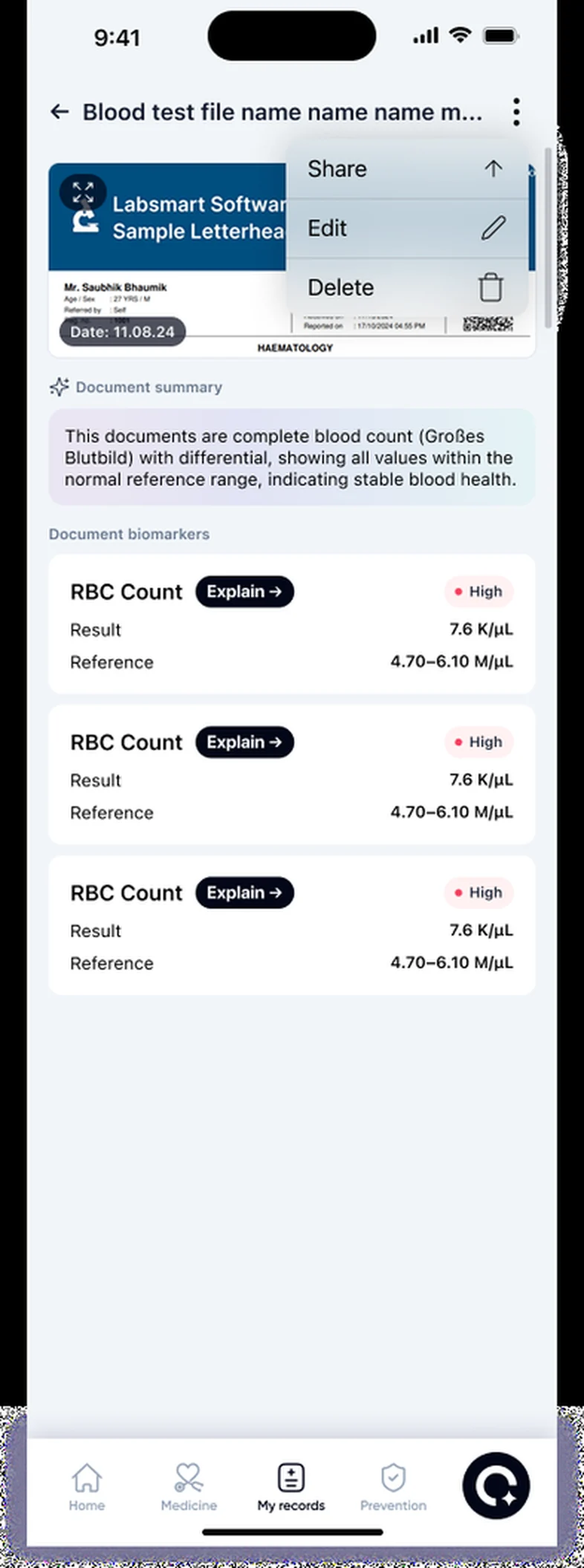
In the free ONU app on iPhone, you can upload and store your lab reports, including your vitamin D results, and see them next to your daily sleep, recovery and activity trends. Because vitamin D can change with the seasons, keeping every report in one place makes it easier to compare a winter result with a summer one when you talk to your doctor.
Our free prevention checks cover eight areas, from blood pressure to stress, and each ends with a summary to take to your doctor. For the rest of your blood test, see blood test results explained.
See a GP if you have bone pain, muscle weakness or keep breaking bones, if you think you or your child might have rickets or osteomalacia, or if your vitamin D level is outside your lab’s range and nobody has explained it yet.
If you take vitamin D supplements and develop nausea, vomiting, muscle weakness or confusion, get medical advice promptly and mention how much you take. The NIH says very high levels can cause an irregular heartbeat and kidney failure. If someone is confused, very weak or has an irregular heartbeat, call your local emergency number. See emergency information.
Bring your everyday signals and health information into a clearer picture.