Key takeaways
A biological age is a calculation that compares some of your measurements with what is typical for people of different ages. The National Institute on Aging describes aging clocks in exactly those terms. Researchers find these clocks useful for studying groups of people, and some are linked with future health in large studies.
For one person, though, the number can shift with short-term events: an NIA-supported study found that biological age measured by DNA-based clocks rose after emergency surgery and fell back within days. Tests from different companies use different inputs and are not interchangeable. The habits that matter for healthy ageing are the same whatever your result says.
Biological age test accuracy: what research shows
Accuracy means different things here. A clock can be very good at guessing someone's calendar age and still not be very useful for predicting their health. The clocks researchers value most are the ones linked with future outcomes.
The NIA reports that in long-term studies, people with faster DunedinPACE scores had a higher risk of poor health, chronic disease and earlier death. That is a real finding, but it is about groups of people followed over many years. It does not mean a single test result tells you how long you personally will live, or which disease you will get.
Why two tests can disagree about the same person
If you send samples to two companies, you may get two different ages. That is expected, not a sign that one is broken. They may measure different things, such as blood chemistry in one case and DNA methylation in another, and use models trained on different groups of people.
Even two DNA-based clocks can weigh different sites and give different answers. Each result is only meaningful against the model that produced it. Before trusting a number, find out what went in, which population the model was built on, and whether the method has been tested and published independently.
Calendar age and modelled age are different things
Your chronological age is a fact. A biological age is a calculation. A company or research team takes some measurements, feeds them into a model built on other people's data, and reports the age at which those measurements would be typical.
The NIA explains it this way: if your biomarkers resemble those of a typical 55-year-old, you would be considered biologically 55. It is a comparison with a reference population, not a reading from a gauge inside your body. That difference is the key to understanding both what these tests can offer and where their accuracy runs out.
What a biological age is trying to capture
The idea behind biological age is reasonable. The NIA describes it as reflecting the molecular damage that builds up over time and eventually leads to disease and disability, and notes that people age at different rates. Two 50-year-olds can have very different health, fitness and risk.
Researchers want a measure that captures that difference earlier and more precisely than calendar age, partly to test whether treatments can slow ageing. NIA's own research blog describes biomarkers of ageing as still being developed and validated, including epigenetic clocks based on blood and saliva samples. In other words, this is an active research field, not a settled clinical test.
The main types of biological age test
Some tests use blood markers, the same kinds of values you see on a routine blood test, combined into a single age. Some use chemical tags on DNA, called methylation, which change in patterns linked to age; these are often called epigenetic clocks. Some estimate the age of particular organs from blood proteins.
Others use fitness, heart rate or sleep data from a wearable. Each captures a different slice of you, which is why results disagree. The NIA also describes a newer type, DunedinPACE, which estimates how fast you are ageing rather than how old you are, using DNA methylation linked to changes across many organ systems over 20 years.
Fitness and wearable ages
Some apps and wearables now show a fitness age, heart age or similar figure based on your activity, resting heart rate, heart rate variability or estimated fitness. These can be motivating, and the inputs are things you can change through exercise and sleep. They are still modelled numbers, built on each company's own assumptions, and they are not the same as the DNA or blood-based clocks used in research.
Two brands can give quite different ages for the same person. Treat a wearable age as a rough summary of your fitness and recovery habits, and watch the trend over months rather than reacting to a single number.
Organ ages and ageing speed
Newer research tries to go beyond one overall number. The NIA describes work estimating the age of individual organs from levels of proteins in the blood, and reports that faster ageing in one organ was linked with a higher risk of disease in that organ. It also notes that differences in biological age can appear years before disease does, which is why researchers are interested in tracking ageing earlier in life.
These are promising research directions. They are also a reminder of how young the field is: different approaches capture different parts of ageing, and none has yet become a standard clinical measure your doctor would order.
How one well-known clock was built
It helps to see how a clock is made. The NIA explains that DunedinPACE came from the Dunedin Study, which has followed more than 1,000 people born in New Zealand in 1972 and 1973. Researchers checked their health at four points between the ages of 26 and 45, measuring 19 markers of how different organ systems were working, and collected blood for DNA methylation.
Using machine learning, they looked for methylation patterns at age 45 that matched how much those markers had changed over 20 years. That is careful work, but it also shows the limits. The model learned from one group of people born in one country at one time.
How well it carries over to someone with a different background is exactly the kind of question still being studied.
Clocks show links, not proof
Most biological age clocks are built by comparing people with a general population reference, and the best of them are linked with later disease and death in long-term studies. The NIA is careful about what that means. A link between a faster clock and poorer health is an association.
It does not prove that pushing the clock down will improve your health, in the same way that a lower number on a thermometer does not cure an infection. To show that slowing a clock actually helps, researchers would need to follow people for many years, because differences in biological age can appear long before disease does. Until that evidence exists, a better score is a hopeful sign at most.
What biological age cannot tell you
A biological age cannot tell you whether you have a particular disease, whether you need a screening test, or how long you will live. It does not replace blood pressure checks, cholesterol tests, cancer screening or a conversation about your family history. It also cannot tell you why your number came out as it did.
If your result is older than you expected, the useful next step is to check the measures with clear meaning and clear treatments. If it is younger, that is pleasant news but not a reason to skip recommended care. In both cases, the habits that support healthy ageing are the same.
Why your result can move from week to week
Biological age is not fixed, and that cuts both ways. An NIA-supported study published in Cell Metabolism in 2023 found that biological age measured by DNA methylation clocks rose in people after emergency surgery and returned to their earlier level within four to seven days. The same pattern appeared around pregnancy and in older adults with severe COVID-19.
The researchers saw this as a sign that biological age can be reversible. For anyone taking a test, it also means a result can reflect a recent illness, injury or stressful period rather than your long-term state. Timing matters.
How sample handling affects results
Accuracy is not only about the model. It also depends on how the sample is collected, stored and processed. In its research blog on biomarkers of ageing, the NIA lists understanding how collection and storage conditions affect these measurements, and how much markers vary in human populations, among the work still needed.
For a home kit, that means a finger-prick blood spot or saliva sample posted to a lab can be affected by how well you followed the instructions and how long it took to arrive. A good provider should explain how it checks sample quality and what happens if a sample fails.
What still has to be proven
Before a measure of ageing can be trusted for individual decisions, it has to clear several hurdles. The NIA research blog on biomarkers of ageing describes the work still needed: refining the laboratory methods, testing how much markers vary across different human populations, linking them to outcomes in long-term cohort studies and clinical trials, and checking whether they predict a range of health outcomes in diverse groups of people. Another open question is whether a marker measured in blood reflects what is happening in other tissues and organs.
The same blog lists epigenetic clocks among the measures still being validated as markers of healthspan and lifespan. A consumer test that skips over these questions is offering more certainty than the science has.
Why researchers are investing in this anyway
None of this means biological age is a dead end. The NIA research blog notes that by 2050 roughly a quarter of the world's population is expected to be older adults, which makes ways to keep people healthy for longer a priority. Reliable markers of ageing could help researchers test treatments faster, without waiting decades to see who becomes ill.
The NIA also describes a hope that a measure like DunedinPACE might one day flag people who are ageing faster than normal, so that doctors could start screening earlier, with cancer screening given as an example. That is a future use under study, not something consumer tests can do today.
A changed score is not a changed outcome
If your score drops by three years after a month of a new routine, the model's inputs changed. That may be welcome. It does not show that your risk of illness changed by the same amount, and it does not show that a particular product caused it.
In the NIH-funded CALERIE trial, healthy middle-aged adults who cut their calorie intake for two years showed a small but significant slowing on DunedinPACE compared with a control group. The NIA describes that effect as small and limited to that group. Even in a well-run trial, then, changes are modest, and their link to longer life is still being studied.
What the calorie trial really involved
The CALERIE trial is often quoted, so the details are worth knowing. According to the NIA, more than 200 healthy middle-aged volunteers were randomly placed either in a group asked to cut daily calories by 25 percent for two years, with dietary and behavioural support, or in a group that kept eating as usual. 5 percent on average, roughly 250 fewer calories a day on a 2,000-calorie diet, and lost about 10 percent of their body weight, mostly fat.
Their DunedinPACE slowed slightly, while the control group did not change. Muscle tissue also declined slightly, though strength held up. This was a supervised research study, not a plan to copy at home without medical advice.
Most anti-ageing headlines come from early research
Stories about reversing ageing often rest on early work in animals. The NIA describes research in which blood plasma from young mice, and later human umbilical cord plasma, improved learning and memory in old mice, and a protein called TIMP2 was identified as one factor involved. Trials in people have been started, but the NIA says plasma-based treatments may still be some time away from widespread use, and describes age-reversing therapies in general as still some way in the future.
Findings like these are exciting for science. They are not evidence that any product, infusion or test you can buy today will turn back your biological clock.
Common myths about biological age
The first myth is that your biological age is a hidden truth about you that a test simply reads. It is an estimate from a model. The second is that a younger result means you are protected from disease.
It does not rule anything in or out. The third is that a supplement, cleanse or programme that lowers your number has been shown to extend life. The NIA describes age-reversing therapies as still well in the future.
The fourth is that tests are interchangeable, so you can compare a result from one company with another. The fifth is that an older result means damage has been done that cannot be changed. Research suggests biological age can move.
Ask what was measured and what was inferred
A good test provider should be able to tell you clearly what they measure, how the sample is taken, which model they use and what evidence supports it. Look for whether the method has been published in peer-reviewed research, whether it has been tested on people like you, and whether the company explains how much results vary on repeat testing. Be cautious if the report bundles a biological age with a list of supplements or programmes to buy. The NIH Office of Dietary Supplements notes that supplements are not tested to show they work before they are sold, so a lower score is not evidence that a product helped.
Questions to ask before you buy a test
A few questions help you judge any biological age product. What exactly does it measure, and from what kind of sample? Which model turns that into an age, and has it been published?
Was the model built on people of my age, sex and background? How much does the result vary if the same person tests twice, close together? What does the company recommend doing with the result, and is it trying to sell me something on the back of it?
Can I share the report with my doctor? If the answers are vague, or the main selling point is a product bundle, treat the number with extra caution.
What is worth acting on
Ask yourself what you would do differently if the number moved. If the answer is sleep more regularly, stay active, do not smoke and keep up with check-ups, you can do that without a test. The National Institute on Aging points to those same everyday habits for healthy ageing.
Measures you can explain, such as blood pressure, cholesterol, blood sugar, waist size, or how far you can walk comfortably, are easier to act on than a single modelled age. They also have clear targets and treatments, which a biological age does not. Start with the numbers your doctor already checks.
What the evidence says helps people age well
The NIA summarises a wide body of research on healthy ageing. Regular exercise is linked to longer life and more years without disability; in one study of adults aged 40 and over, people who took 8,000 or more steps a day had a 51 percent lower risk of death from any cause than those taking 4,000. Quitting smoking helps at any age.
Eating patterns such as the Mediterranean and DASH diets are linked to better heart health. Seven to nine hours of sleep, regular check-ups, treating high blood pressure and staying socially connected all feature too. Most of these findings are observational, so they show links rather than proof.
Using a result responsibly
Treat a biological age as a conversation starter, not a verdict. Keep the report, note which test it came from and when, and compare only with the same test later, taken under similar conditions. Avoid testing during or just after an illness, surgery or a very stressful period, since research shows those can push the number up temporarily.
Do not use a result to rule a health problem in or out, and do not skip recommended screening because a test says you are young for your age. Be wary of anyone selling a product on the promise of lowering your number, and talk to your doctor before acting on it.
Practical steps this week
If you are curious about your biological age, start with the measures that already have clear meaning. Check when you last had your blood pressure, cholesterol and blood sugar tested, and book a check-up if it has been a while. Pick one habit from the research on healthy ageing that you can keep: a daily walk, a regular bedtime, an extra portion of vegetables, or cutting back on alcohol.
If you still want a test, read how it works before buying, avoid timing it after an illness, and plan how you will use the result. Write down what you would change if it came back older or younger.
A worked example
Elena, 47, takes a DNA-based test that reports a biological age of 52. She is upset, then remembers she took the sample two weeks after a bad bout of flu. A blood-based test she took last year, from another company using a different model, had put her four years under her calendar age, so she wonders which to believe.
Instead of buying the supplement bundle offered with her report, she books a check-up. Her blood pressure is slightly raised and she has been sleeping poorly. She works on sleep and walking and has her blood pressure rechecked.
Those are numbers she can track and act on with her doctor.
When to see a doctor
A biological age result on its own is not a reason for urgent care, but it can be a prompt to book a routine check-up, especially if you have not had one recently. The NIA advises seeing a doctor at least once a year and notes that regular visits help find chronic conditions early and manage risk factors such as high blood pressure and cholesterol. See a doctor sooner if you have symptoms such as unexplained weight loss, lasting tiredness, chest pain or breathlessness, whatever any test says. Bring your test report if you like, but expect your clinician to focus on measures with established meaning.
How ONU fits
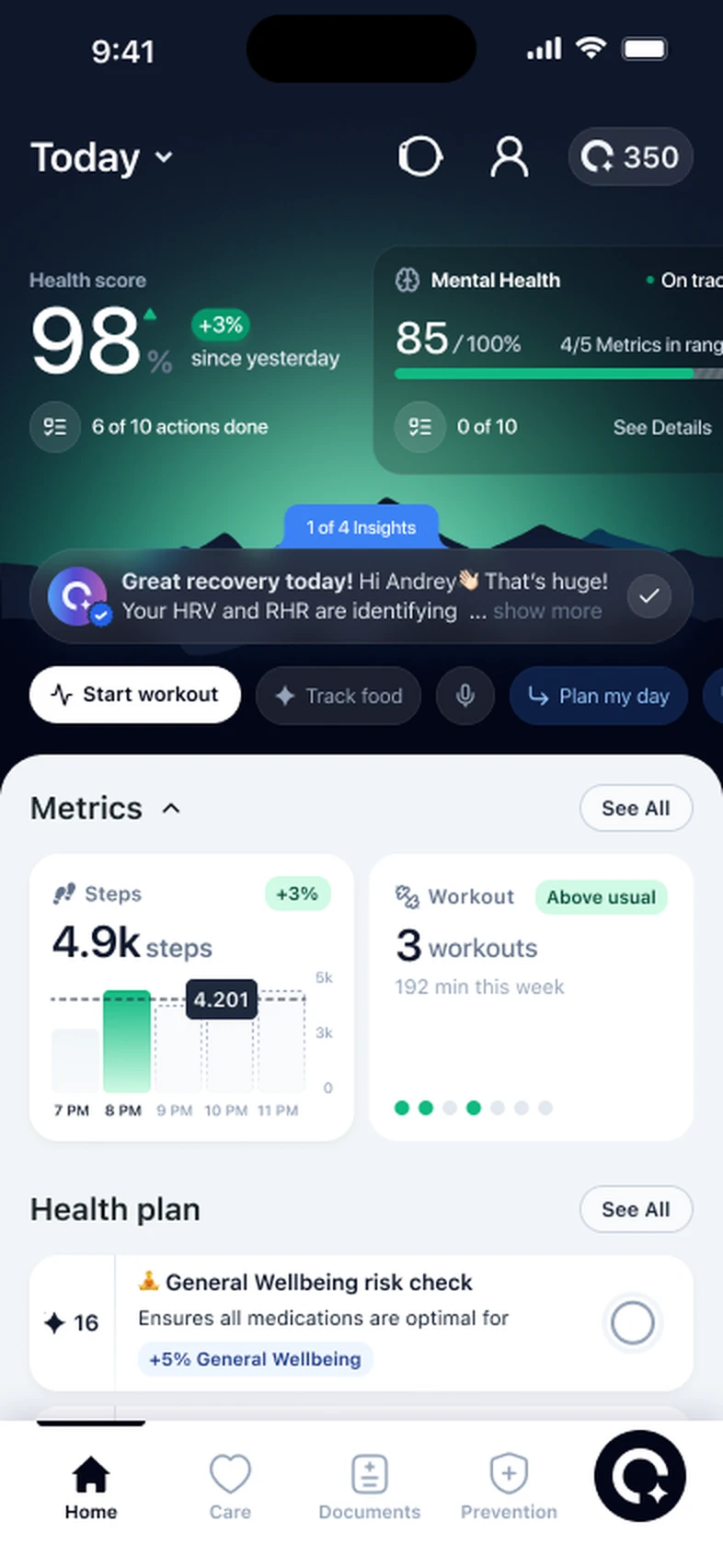
ONU does not sell a biological age test or any lab test. It shows your sleep, recovery and activity in a daily ONU Score compared with your own baseline, with weekly and monthly trends, and stores lab reports you upload. Those are day-to-day measures and records you can actually act on.
ONU also offers free prevention checks on the site for areas such as blood pressure, cholesterol and type 2 diabetes, each ending with a summary to take to a doctor. ONU is a wellness product, not a medical device. It does not diagnose, treat or prevent disease, and it does not estimate a biological age.
Common questions
Can two biological age tests give different results?
Yes. They use different measurements and different models, so disagreement is expected. Compare results only within the same test over time.
Which biological age test is most accurate?
There is no agreed standard. Look for a clear description of what is measured, published research on the method and independent testing.
Is a biological age test a medical test?
Consumer biological age tests are not used to diagnose disease. Talk to your doctor about tests with established meaning, such as blood pressure, cholesterol and blood sugar.
What should I do if my result is older than my real age?
Do not panic. Check when the sample was taken and what the test measures, then focus on the habits and check-ups that are known to support healthy ageing.
Are supplements sold with these tests proven to work?
There is no good evidence that they slow ageing in people. The NIA describes age-reversing therapies as still well in the future, and the NIH notes that supplements are not tested to prove they work before they are sold.
How often should I repeat a biological age test?
There is no agreed schedule. If you retest, use the same test under similar conditions, and allow months rather than weeks, since short-term events can shift results.
Should I cut calories to lower my biological age?
Not on your own. In the CALERIE trial, a supervised two-year calorie cut slowed one ageing measure only slightly and also led to a small loss of muscle tissue. Talk to a doctor or dietitian before making big changes to how much you eat.
What to do next
Sources and further reading
- National Institute on Aging: Healthy agingnia.nih.gov
- National Institute on Aging: What do we know about healthy aging?nia.nih.gov
- National Institute on Aging: Research in context, can we slow aging?nia.nih.gov
- National Institute on Aging: Stress-induced increases in biological age are reversiblenia.nih.gov
- National Institute on Aging: In search of better biomarkers of agingnia.nih.gov
- NIH Office of Dietary Supplements: Dietary supplements, what you need to knowods.od.nih.gov
General educational information, not a diagnosis or a personal treatment plan. Device information is identified separately from independent health guidance. Speak to a qualified professional about anything that concerns you.