Key takeaways
A good HRV is a personal number, not a universal one. Compare today with your own recent range, measured with the same device in the same way. Large research samples show a wide spread among healthy adults, so a reading that looks low on a chart can be perfectly normal for you.
Short-term dips usually follow ordinary things like a short night, alcohol, a hard workout or a stressful day. A run of low readings together with a higher resting heart rate is a fair cue to ease off. HRV from a wearable cannot diagnose anything, and symptoms such as chest pain or fainting always come before any score.
What HRV actually is
Your heart does not tick like a metronome. Even at rest, the gap between one beat and the next keeps changing by tiny amounts. Heart rate variability, or HRV, is a measure of that change, usually reported in milliseconds.
It is not the same as heart rate. A pulse of 60 does not mean your heart beats exactly once every second. The spacing stretches and shrinks as your body responds to breathing, posture, effort, digestion and stress.
Shaffer and Ginsberg's 2017 review describes this beat-to-beat variation as a normal feature of a healthy heart, and treats HRV mainly as a window into how your nervous system is adjusting from moment to moment.
Why your breathing and heart rate change the number
Two things move HRV more than most people expect. The first is breathing. When you breathe in, your heart rate speeds up a little, and when you breathe out it slows again.
The 2017 review notes that slower, deeper breathing makes this swing larger, which is why a calm, slow-breathing moment can show a higher reading. The second is heart rate itself. The same review reports that faster heart rates are linked with lower HRV.
So on a morning when your resting pulse is up, a lower HRV is partly the same signal seen from another angle, not a separate problem.
What is a good HRV range for adults
If you want reference points, the most useful ones come from large pooled studies. Shaffer and Ginsberg summarise work by Nunan and colleagues covering 21,438 healthy adults measured over short resting recordings. In that data the average RMSSD, the measure many wearables report, was about 42 milliseconds, with typical values running from roughly 19 to 75.
That is a very wide band. Someone sitting at 25 and someone sitting at 70 can both be healthy. These figures came from short daytime recordings, though, and the review warns that norms from different recording lengths cannot be swapped.
An overnight wearable average is a different measurement, so treat any published range as rough context only.
Why there is no single good number
HRV depends on your age, your genes, your fitness and even how your device measures it. The 2017 review reports that several HRV measures decline steadily with age, and that a large analysis of nearly 300,000 healthy people found average differences between men and women. Aerobic fitness tends to raise HRV, while poorer health tends to lower it.
Longer recordings also produce higher values than short ones. Put all of that together and a reading of 30 milliseconds means nothing by itself. It could be typical for one person and a real drop for another.
The fair comparison is you against you.
What the numbers on your wearable mean
Most wearables show an overnight figure, often an average across the night. Oura, for example, explains that it records HRV throughout sleep and that HRV usually rises while resting heart rate falls as the night goes on. That rise is one reason a short night can produce a lower average: you simply missed some of the later, calmer hours.
When you look at your number, ask three questions. Is it inside my usual range for the past few weeks? Is my resting heart rate also up?
Do I feel different? A reading inside your range with a normal pulse and no symptoms needs no action at all.
What pushes HRV down
A short or broken night. Alcohol, especially in the evening. A hard training block without enough rest.
Coming down with a cold. A stressful stretch at work, a late meal, a long flight or a hot bedroom. Any of these can be followed by a lower reading, and none of them means something is wrong with your heart.
The NHS lists many of the same everyday triggers, including poor sleep, stress, alcohol and caffeine, as common reasons for noticing your heartbeat more. Expect your HRV to bounce around from day to day. Most of that movement is your body reacting sensibly to the day you just had.
If work stress is a big part of the picture, the free burnout test helps you see how far it has gone.
What tends to help
The unglamorous things. Regular sleep at roughly the same times, and enough of it. Staying active most days, with easier days after hard ones.
Going easy on alcohol, especially in the hours before bed. Giving yourself room to wind down in the evening, whether that is a walk, a book or a few minutes of slow breathing. None of this is a trick for raising a number.
These are the same habits that help you feel better, and HRV often follows over weeks rather than days. If a change only moves your HRV and does nothing for how you feel, it probably is not worth chasing. Sleep is the habit most worth protecting, and the sleep articles go into it in more detail.
Common myths about HRV
The first myth is that higher is always better. The 2017 review points out that some heart rhythm problems, such as atrial fibrillation, can actually raise HRV, so an unusually high reading is not automatically good news. The second myth is that you can compare your number with a friend's.
Different devices, recording times and methods make that comparison almost meaningless. The third is that one bad morning means you are overtrained or ill. Single readings are noisy, and the same review notes that a single movement or signal error can distort a short recording.
Look for patterns across several days, not one dramatic dip.
Getting a fair reading
Small details change HRV more than you might think, so a fair reading starts with a consistent routine. Wear the device snugly and in the same place each night. Avoid switching between a ring, a strap and a watch, because each may sample at different times and handle the signal differently.
The 2017 review stresses that recording length matters and that a single artifact, such as a movement or a poor contact, can distort a short measurement. If you take spot readings during the day, do them at the same time, sitting still and breathing normally, before coffee or exercise. Consistency matters far more than finding the perfect moment.
Practical steps this week
Pick one device and wear it the same way every night for the whole week. Do not judge any single day. At the end of the week, note your lowest and highest readings and where most nights landed.
That is the start of your personal baseline. Alongside it, jot down three things each evening: roughly when you went to bed, whether you drank alcohol, and how hard you trained. You will often see the link on your own.
Pick one habit to hold steady, such as a regular bedtime, rather than changing everything at once. After two or three weeks your range becomes much clearer.
Using HRV for training
Treat it as one input among several. If your HRV has been low for a few days, your resting heart rate is up and you slept badly, an easier session makes sense. If the number is high but you feel ill, trust how you feel.
A score cannot clear chest pain, illness or unusual breathlessness for exercise. Some athletes plan hard sessions on days when HRV sits in their normal range and move them when it drops well below. That is a reasonable way to use the data, as long as you remember that how you feel, how you slept and what your coach or plan says still matter more.
A worked example
Sam usually sees an overnight HRV between 45 and 60 milliseconds, with a resting heart rate around 56. On Saturday Sam goes to a wedding, has several drinks and sleeps five hours. Sunday shows an HRV of 31 and a resting heart rate of 64.
That looks alarming on a chart, but it fits the night perfectly. Sam takes an easy walk instead of a long run and goes to bed early. Monday reads 42, Tuesday 50.
No action needed. Now picture a different week: no obvious cause, four low nights in a row, a raised pulse and a scratchy throat. That pattern is a cue to rest and watch how you feel.
When to see a doctor
HRV from a consumer wearable does not diagnose a heart condition, measure cortisol or confirm you have recovered from an illness. The American Heart Association advises calling emergency services if your heart rate is suddenly very high or very low for you, especially with chest pain, shortness of breath, dizziness or fainting. The NHS gives the same emergency signs for palpitations.
Book a routine appointment if your heartbeat often feels irregular, racing or pounding, if palpitations keep coming back or last more than a few minutes, or if you have a heart condition or a family history of heart problems. Bring your notes, not just screenshots. If heart disease runs in your family, the free heart disease risk check shows which numbers to gather before that appointment.
How ONU fits
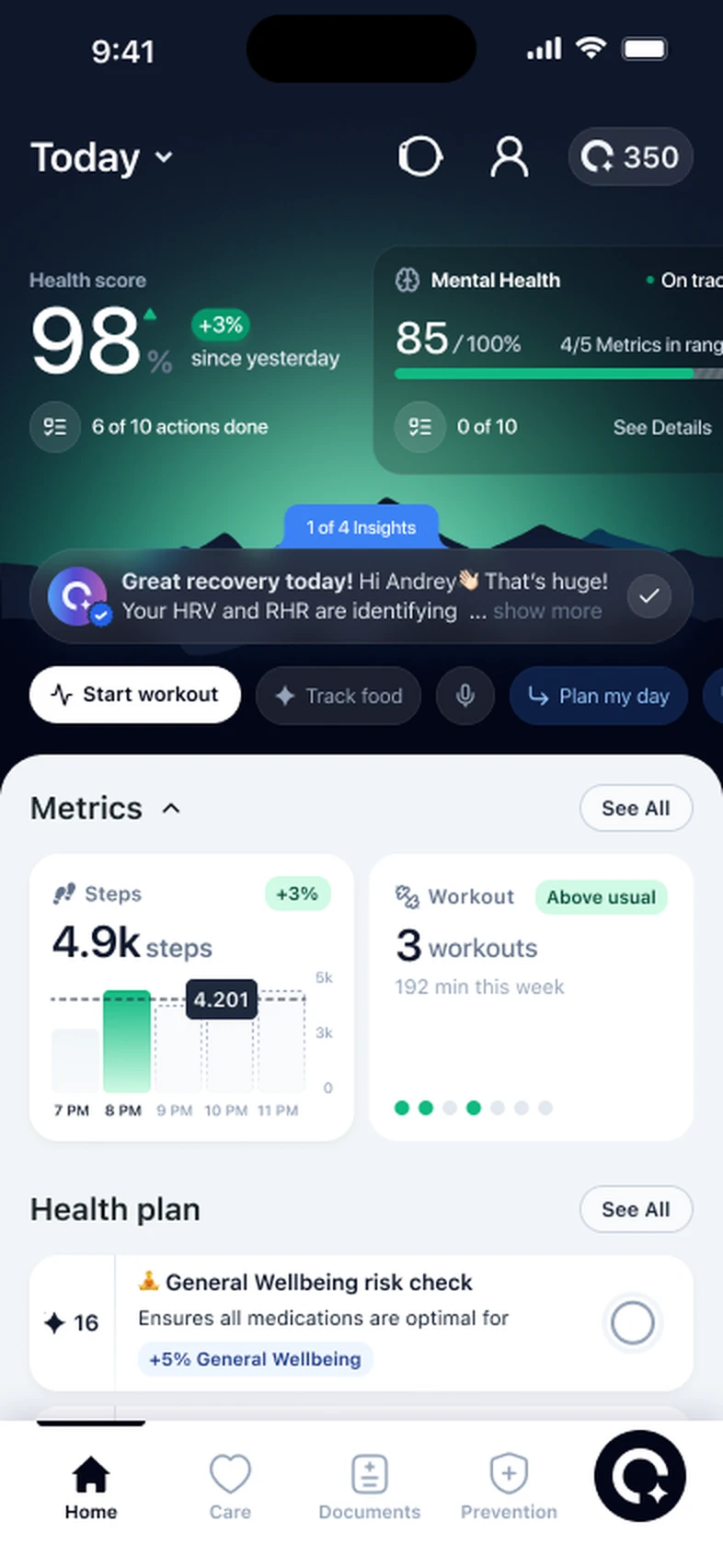
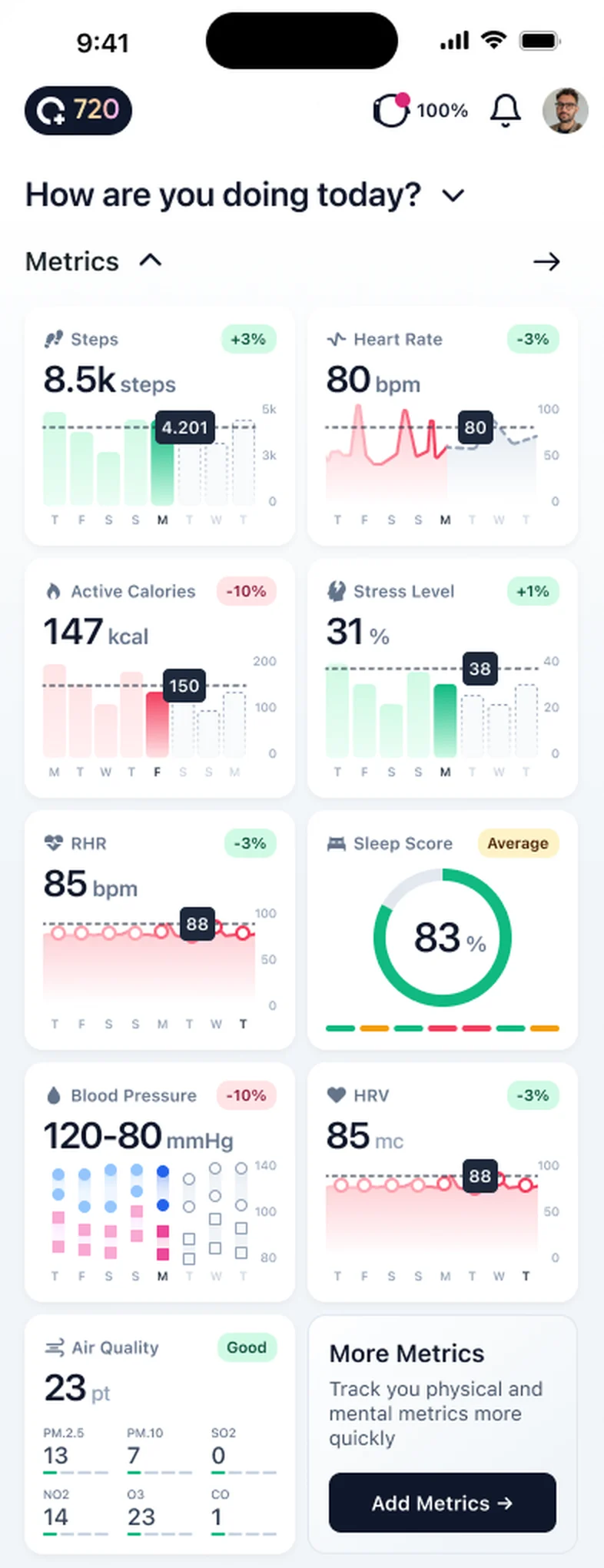
ONU reads HRV from the ONU Bracelet or from the wearable you already use, such as WHOOP or Garmin, or Apple Watch and Oura through Apple Health on iPhone. It folds HRV into your daily ONU Score alongside sleep, resting heart rate and activity, compared with your own baseline rather than a population chart. You see weekly and monthly trends in one place, plus one small suggested step a day.
ONU is a wellness product, not a medical device, so it shows patterns but does not diagnose anything. What the bracelet measures, and what ONU has and has not published about accuracy, is set out on the science page.
Common questions
Is a higher HRV always better?
Usually, compared with your own baseline, a higher reading is a good sign. But some heart rhythm problems can raise HRV, so an unusually high reading needs context, and it never overrides feeling unwell.
What is a good HRV for my age?
There is no fixed figure per age. Research shows HRV tends to fall as people get older and varies widely between healthy people of the same age. Your own range over several weeks is the best guide.
Why is my HRV low after drinking?
Alcohol tends to raise your heart rate and disturb your sleep, and HRV often drops that night. It usually recovers within a day or two once you sleep normally again.
Can I compare my HRV between WHOOP and Oura?
Only loosely. They may measure at different times of the night and process the signal differently. Track change within one device rather than comparing brands.
How long does it take to learn my baseline?
Give it at least a week or two of consistent wear before reading much into the numbers. A month gives a clearer picture, because it includes good weeks and busy ones.
Can a wearable tell my cortisol level from HRV?
No. HRV is not a hormone measurement. Cortisol needs a clinical test ordered by a clinician.
Should I worry about one very low reading?
Usually not. Look at what happened the day before and check the next few nights. Get medical advice if low readings come with symptoms such as chest pain, fainting, breathlessness or a heartbeat that feels wrong.
What to do next
Sources and further reading
- American Heart Association: Heart rate and pulseheart.org
- WHOOP: Heart rate variability explainedwhoop.com
- Oura: Overnight HRV dataouraring.com
- Shaffer & Ginsberg (2017): An overview of heart rate variability metrics and normsfrontiersin.org
- NHS: Heart palpitationsnhs.uk
General educational information, not a diagnosis or a personal treatment plan. Device information is identified separately from independent health guidance. Speak to a qualified professional about anything that concerns you.