Key takeaways
A sleep score is a summary, not a measurement. Each brand builds it from its own mix of ingredients and weights them differently. The most solid inputs are how long you slept and how regular your timing was.
Stage estimates such as deep and REM sleep are the least precise. Use the score to see trends across a week or a month, and always check it against how you actually feel during the day. A high score does not rule out a sleep disorder such as sleep apnoea, and a low score after one unusual night does not mean you have a problem.
If tiredness lasts for weeks, talk to a clinician.
What goes into a sleep score
It depends on the brand. Oura, for example, says its score draws on seven contributors: total sleep, efficiency, restfulness, REM sleep, deep sleep, how long you took to fall asleep, and timing relative to your body clock. Other devices lean more on duration and efficiency, or add heart rate and breathing.
That means one total can hide a trade-off. You might have slept longer but at an odd hour, or stayed in bed for nine hours and woken up a dozen times. Read your own device's explanation before you read meaning into a change, because a drop can come from one ingredient while the others look fine.
How the ONU Score uses your sleep
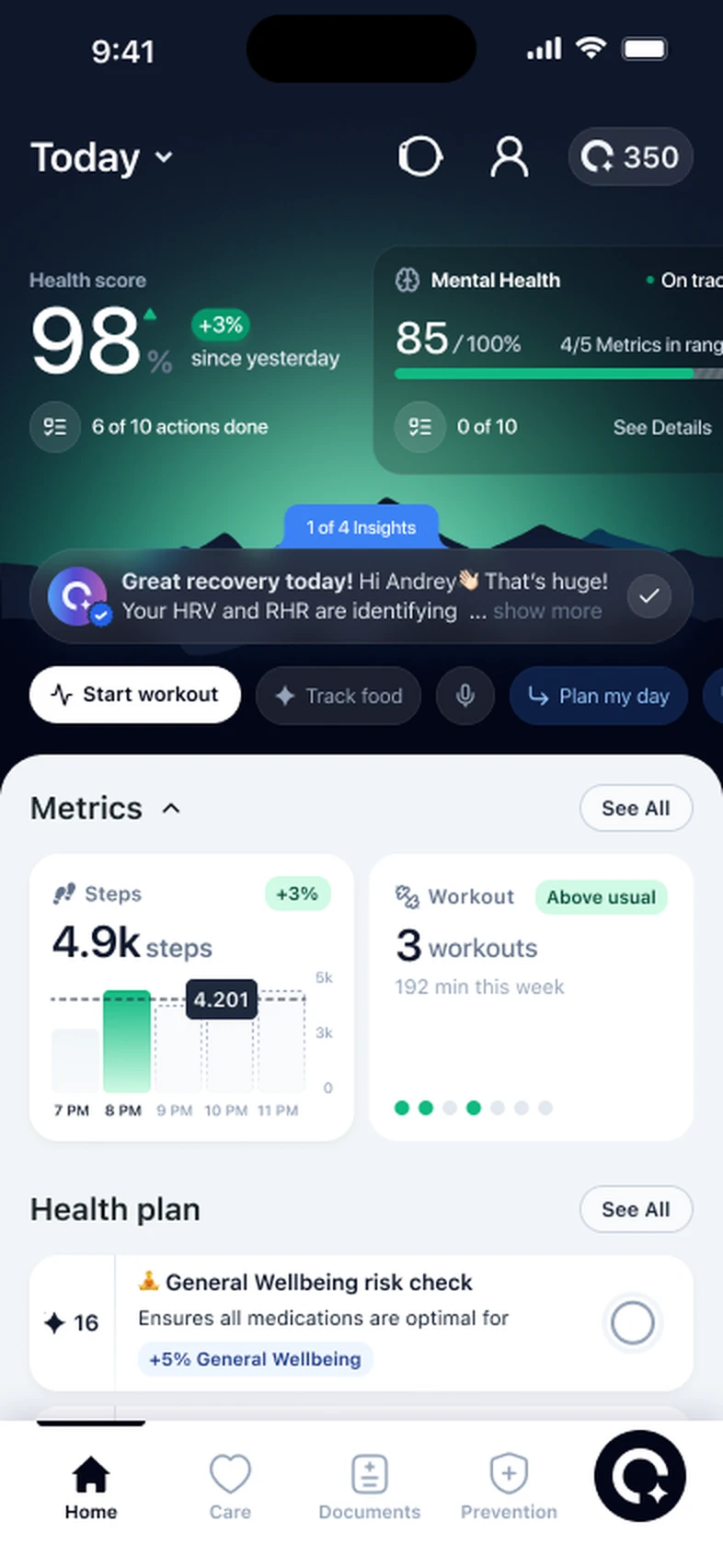
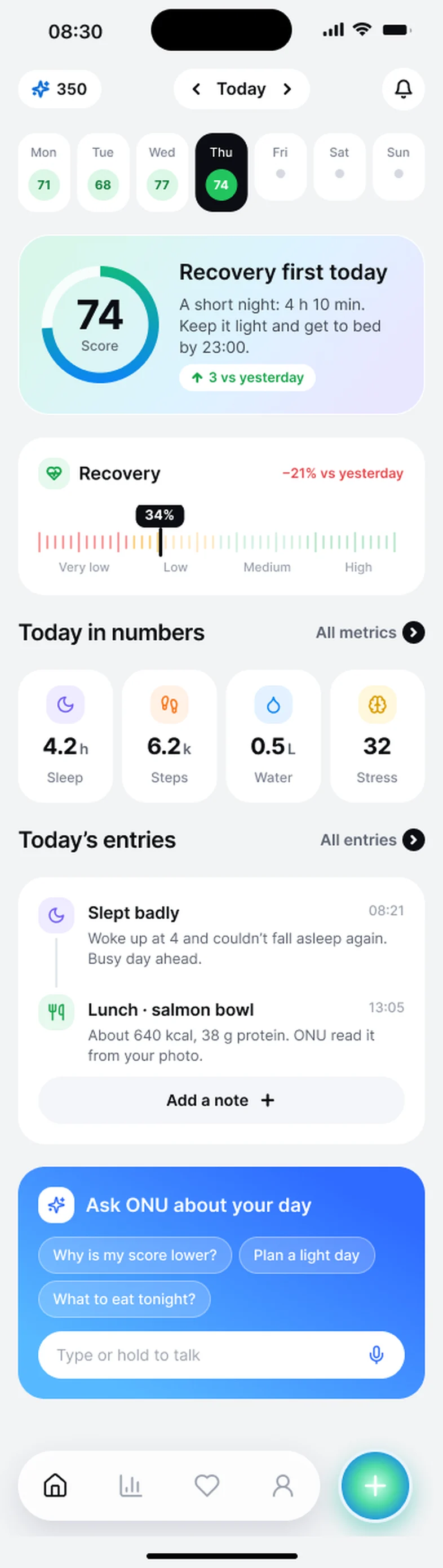
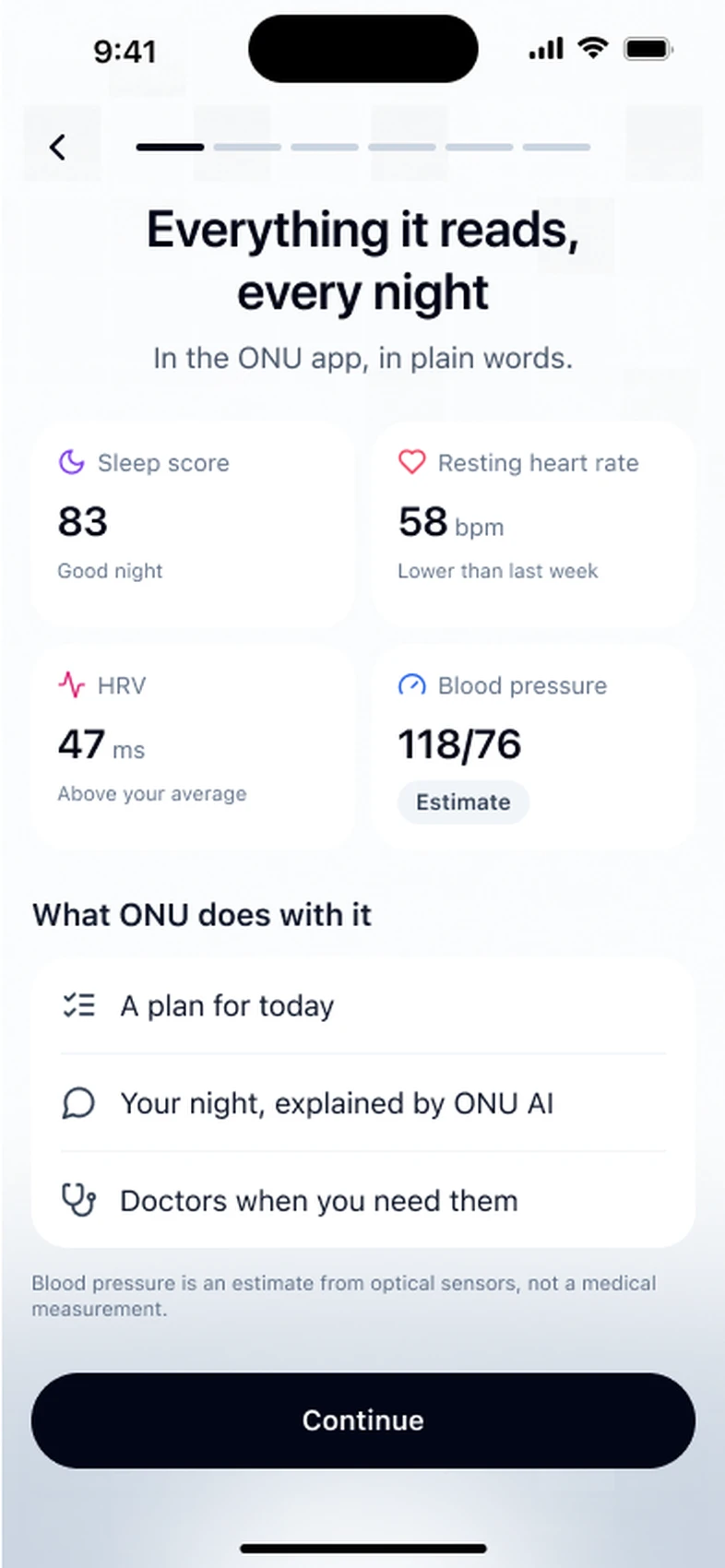
ONU does not ask you to read a sleep score on its own. Last night's sleep goes into one daily ONU Score together with your recovery signals, heart rate variability and resting heart rate, and your activity. That score is compared with your own baseline rather than a population average, so a short night counts against your usual pattern, not against a stranger's.
It means you can see whether a poor night shows up in your HRV and resting heart rate the next morning, or stands alone, and follow the weekly and monthly trend rather than one night. The sleep data can come from the ONU Bracelet or from the wearable you already use: WHOOP and Garmin connect directly, and Apple Watch and Oura reach ONU through Apple Health on iPhone. Each day the app suggests one small step, such as a steadier bedtime.
The ONU app includes the daily score and sleep insights, with every feature free for 3 days before ONU Pro. ONU is a wellness product, not a medical device, so like any sleep score it cannot diagnose a sleep disorder.
Sleep score explained, ingredient by ingredient
Total sleep is the time the device thinks you were asleep, not the time you spent in bed. The CDC recommends at least seven hours a night for adults aged 18 to 60. Efficiency is the share of time in bed you spent asleep; Oura treats about 85 percent as a strong result.
Restfulness reflects how much you moved or woke. Latency is how long you took to drop off, and Oura describes 15 to 20 minutes as typical, noting that falling asleep in under five minutes can be a sign you are overtired. Timing looks at whether your sleep sits at a consistent point in your body clock.
Why timing and regularity matter
Many people focus on hours and ignore when those hours happen. Yet timing is one of the parts of a score you can change most easily. Oura, for instance, rewards a sleep midpoint that falls roughly between midnight and three in the morning, and penalises sleep that drifts later.
The CDC's first piece of advice for better sleep is to go to bed and wake up at the same time every day, weekends included. A regular wake time anchors your body clock, so you tend to feel sleepy at a similar time each evening. If your scores swing between weekdays and weekends, irregular timing is often the reason.
Why the stages are estimates
A band or a ring works out sleep from movement and heart signals. It does not record brain activity the way a clinical sleep study does. Oura reports that in a study of 35 adults, its third-generation ring agreed with a sleep lab recording about 92 percent of the time for sleep versus wake, but about 76 percent of the time across all four sleep stages.
That is useful, but it is not exact. So treat a line like one hour 42 minutes of deep sleep as a rough guide. Fit, wear time and software updates can change the result even when your nights have not changed.
What the ONU Bracelet measures, and its limits, is set out on the science page.
What the numbers mean
Most scores run from 0 to 100. Oura labels 85 and above as optimal, 70 to 84 as good, and under 70 as a sign that something could be adjusted. Other brands use different bands, so the same 78 can mean different things on different devices.
Within your own device, small moves of a few points from night to night are normal noise. What matters is the direction across a week, and whether a low score keeps coming from the same ingredient. If efficiency is always the weak spot, the issue may be time awake in bed.
If timing drags you down, it may be an irregular schedule rather than short sleep.
Why the score can disagree with how you feel
The device summarises signals. It does not experience your night. Noise, pain, a restless partner, a full bladder or simple worry may barely show in the total.
You can also lie very still while awake, which a device may count as sleep. If you feel sleepy, drained or foggy on a day the score says 88, believe yourself and note it. The CDC describes good sleep as uninterrupted and refreshing, and lists feeling tired even after enough sleep as a sign of poor quality.
How you function during the day is the real result, and the score is only an attempt to predict it.
Common mistakes with sleep scores
The first mistake is chasing deep sleep minutes. Stage estimates are the least reliable part of the score, and there is little you can do to force more deep sleep on a given night. The second is comparing scores with a partner or friend on a different device.
The third is checking the score in bed and then lying awake worrying about it. The fourth is letting one bad night shape your whole day. A poor score after a late dinner, a long flight or a sick child is simply an accurate record of a rough night.
The fifth is assuming a high score clears you of a sleep problem.
What actually moves the score
The habits that help are the ones public-health bodies have recommended for years. The CDC suggests going to bed and getting up at the same time every day, keeping the bedroom quiet, relaxing and cool, turning off screens at least 30 minutes before bed, avoiding large meals and alcohol close to bedtime, avoiding caffeine in the afternoon and evening, and staying active during the day. These tend to improve duration, efficiency and timing, which are the most dependable parts of any score.
They will not guarantee a particular number, but they usually help you feel better, which is the point. Each habit is covered in more depth in the sleep articles.
A simple way to use a week of scores
Look first at the time you gave yourself to sleep, and how regular your bedtime and wake time were. Then look at how you felt during the day. Pick one small experiment, such as a steadier wake-up time or moving your last coffee to before lunch, and keep it for a full week.
Compare the average of that week with the one before, not individual nights. If the score makes you anxious at bedtime, stop checking it daily and look once a week instead. It is a tool, not a grade, and you are allowed to ignore it on a night you know was unusual.
A worked example
Leo's scores usually sit in the high seventies. One week they drop into the low sixties. Looking at the ingredients, total sleep is fine at around seven and a half hours, but timing and efficiency have slipped.
He realises he has been watching shows in bed until after midnight, then waking at the usual time and lying awake at three in the morning. He moves screens out of the bedroom, keeps the same wake time on weekends and takes a short walk at lunch. Two weeks later his scores are back in the seventies.
More importantly, he no longer feels foggy in the afternoon meeting.
A sleep score versus a clinical sleep study
A wearable and a sleep test answer different questions. Your score estimates how a night went so you can spot habits and trends. A clinical assessment looks for specific disorders.
The NHS explains that if sleep apnoea is suspected, a GP may refer you to a sleep clinic, where you usually wear monitoring equipment overnight at home. The result is given as the number of times breathing stops or becomes shallow per hour: 5 to 14 is mild, 15 to 30 moderate and over 30 severe. No consumer sleep score reports that figure.
The two work well together, but one cannot replace the other.
When a sleep assessment beats another score
Talk to a healthcare professional if poor sleep or daytime tiredness goes on for weeks, gets in the way of daily life, or comes with loud snoring, gasping or pauses in breathing that someone else has noticed. The NHS lists choking or snorting sounds in sleep, frequent waking, morning headaches, mood changes and extreme daytime tiredness as signs of sleep apnoea, and advises seeing a GP if you have them. A high score does not rule it out.
Bring a short sleep diary and, if possible, the person who has noticed your breathing. Do not drive when you are sleepy.
Common questions
What is a good sleep score?
It varies by device. Oura, for example, calls 85 and above optimal and 70 to 84 good. More useful is a score that is steady for you and matches feeling rested.
Why did my score drop when I slept eight hours?
Interruptions, a later bedtime than usual, taking a long time to fall asleep or a restless night can lower it even when the total time looks fine.
How accurate is deep sleep tracking?
It is an estimate based on movement and heart signals. Wearables agree with sleep lab recordings much better on sleep versus wake than on individual stages.
Can a sleep score detect sleep apnoea?
No. It cannot diagnose a sleep disorder. Symptoms such as loud snoring, gasping and pauses in breathing need a proper assessment.
Should I check my score first thing every morning?
Only if it helps. If it makes you anxious or colours your mood, look at the weekly average instead.
Can I compare scores across devices?
Not directly. Each brand uses different ingredients and weightings, so the same night can produce different numbers.
Why is my score lower on weekends?
Later bedtimes, lie-ins and alcohol often shift timing and break up sleep. Keeping a similar wake time every day usually smooths this out.
What to do next
Sources and further reading
- CDC: About sleepcdc.gov
- NHS: Sleep apnoeanhs.uk
- Oura: Sleep scoreouraring.com
General educational information, not a diagnosis or a personal treatment plan. Device information is identified separately from independent health guidance. Speak to a qualified professional about anything that concerns you.