Key takeaways
The terms cortisol face and cortisol belly come from social media, where they are often used to sell supplements, diets or tests. Cortisol is a normal hormone that rises and falls through the day, and feeling stressed does not mean your level is abnormal. Truly high cortisol over a long period is called Cushing's syndrome.
It is uncommon, and its most frequent cause is long-term use of steroid medicines. A fuller face or more weight around your middle has many everyday explanations. Only blood, saliva or urine tests, chosen and interpreted by a clinician, can show whether your cortisol is high.
Never stop a prescribed steroid on your own.
Where the cortisol face and cortisol belly idea comes from
The trend borrows real features of a real condition and applies them to ordinary bodies. Clinical descriptions of Cushing's syndrome include a rounded face and extra weight around the belly and upper body, and online those features are often linked to any puffy face or soft middle. From there, it is a short step to selling a supplement, a cleanse or a test kit that promises to fix it.
The problem is that the same features have dozens of more common causes. Treating them as a hormone issue can lead to worry, wasted money and, worse, missing the real reason for a change.
When cortisol really does change appearance
MedlinePlus describes Cushing's syndrome as a disorder in which the body has too much cortisol over a long time. Its signs include weight gain around the belly and upper body, a rounded face, thin arms and legs, a fatty pad at the base of the neck or between the shoulders, wide purple stretch marks and easy bruising. People may also have muscle weakness, fatigue, high blood pressure and high blood sugar.
Women can notice extra facial or body hair and irregular or absent periods. Men may notice lower sex drive or fertility problems. Children may gain weight while growing more slowly.
Not everyone has every sign.
Why looks alone cannot tell you
A fuller face or a bigger waistline has many ordinary explanations: weight gain, a salty meal, alcohol, poor sleep, water retention around your period, some medicines, or simply getting older. These overlap almost completely with what people post as cortisol face. Lighting, camera angle and the time of day also change how a face looks in a photo.
NIDDK notes that Cushing's syndrome can be hard to detect even for clinicians, because its signs overlap with other conditions such as polycystic ovary syndrome and metabolic syndrome. That is why no clinician diagnoses a hormone problem from a photo, and you should not either.
Everyday reasons for a rounder face or more belly fat
Most changes in face and waist shape come from overall weight change, and the usual drivers are familiar: eating a bit more than you use, moving less, poor sleep, alcohol and getting older. The CDC links getting enough sleep with an easier time staying at a healthy weight. Stress can play a part through behaviour, such as comfort eating, skipping exercise or sleeping badly, without your cortisol being abnormal in a medical sense.
Some medicines can cause weight gain, and fluid retention can make a face look puffier for a day or two. None of these is a reason to panic, but lasting change is worth discussing.
Measure your waist, not your cortisol
If belly fat is what worries you, a tape measure tells you more than any cortisol video. The US National Heart, Lung, and Blood Institute explains that fat carried around the waist, rather than the hips, raises the risk of heart disease and type 2 diabetes more than fat elsewhere. It suggests a simple check: stand, wrap a tape measure around your middle just above your hip bones, and read it just after you breathe out.
For women, a waist over 35 inches, about 89 centimetres, increases risk; for men, the threshold is over 40 inches, about 102 centimetres. That number is useful whatever is driving it, and it is a better starting point for a conversation with your doctor than guessing at hormones.
What cortisol does
Cortisol is a hormone made by your adrenal glands, which sit on top of your kidneys. MedlinePlus explains that it helps your body respond to stress, keeps inflammation in check, helps regulate blood sugar and metabolism, and helps control blood pressure. A gland in the brain, the pituitary, sends a signal called ACTH that tells the adrenal glands how much cortisol to make.
It is not a bad hormone. You need it every day, and without enough of it you would become seriously unwell. Most people who feel puffy or tired after a hard month have cortisol well inside the usual range.
Cortisol has a daily rhythm
Your cortisol level is not fixed. MedlinePlus notes that it is usually highest in the morning and falls by the afternoon. That rhythm is one reason a single number means little without knowing when it was taken.
It also explains why some tests are timed carefully, such as a morning and afternoon blood sample, or a saliva sample collected late at night. Stress, exercise, pregnancy, hot or cold temperatures and some medicines, including birth control pills, can all affect a result. This is part of why home kits and one-off readings are so easy to misread.
How common Cushing's syndrome is
Cushing's syndrome caused by the body itself is rare. The US National Institute of Diabetes and Digestive and Kidney Diseases estimates about 40 to 70 cases per million people. It mostly affects adults aged 30 to 50 and affects about three times as many women as men.
The most common cause overall is taking glucocorticoid steroid medicines, such as prednisone, at high doses over a long time, for conditions like asthma, rheumatoid arthritis or lupus, or after a transplant. When medicines are not the cause, NIDDK says a non-cancerous pituitary tumour accounts for about eight in ten cases. Other tumours are less common.
Steroids are more common than people think
Because medicines are the leading cause, it is worth knowing how widely they are used. NIDDK notes that more than 10 million Americans take glucocorticoid medicines each year, although only some of them will ever develop Cushing's syndrome. The risk is linked mainly to high doses taken for a long time, for conditions such as asthma, rheumatoid arthritis and lupus, or to prevent rejection after an organ transplant.
NIDDK adds that steroid injections into a joint can also contribute. If you have had repeated courses of steroid tablets or injections, mention them when you talk to your doctor about changes in your weight or appearance, even if the last course was months ago.
Pseudo-Cushing's: when cortisol is high for another reason
Sometimes cortisol tests come back raised without Cushing's syndrome being present. MedlinePlus and NIDDK describe this as pseudo-Cushing syndrome, which can occur with depression, anxiety, heavy drinking or alcohol use disorder, poorly controlled diabetes or obesity. In these situations the raised level reflects another condition, and it usually settles when that condition is treated.
NIDDK notes that doctors may use additional tests to tell the two apart. This is another reason not to over-read a single result from a home kit. A slightly high number does not equal a hormone disease, and the context of your health matters a great deal.
Low cortisol matters too
The online conversation focuses on cortisol being too high, but low cortisol can be a serious problem as well. MedlinePlus explains that low results may point to Addison's disease, where the adrenal glands are damaged, for example by autoimmune disease or infection, or to secondary adrenal insufficiency, where the pituitary gland does not send enough of its signal. These conditions need proper medical care.
This is one more reason why cortisol is not something to push up or down with supplements or routines based on how you look. The goal is not a lower number. It is a level that is right for your body at that time of day.
Why long-term high cortisol matters
The reason clinicians take real Cushing's syndrome seriously is not appearance. NIDDK lists complications that can follow years of high cortisol, including heart attack and stroke, blood clots in the legs and lungs, infections, bone loss and fractures, high blood pressure, unhealthy cholesterol levels, insulin resistance, prediabetes and type 2 diabetes. It can also affect the mind, with depression, mood changes, memory problems and trouble concentrating.
These risks are the reason to see a doctor if you have several of the physical signs together. They are not a reason to fear that a stressful month or a puffy morning has done lasting harm, because those are not the same as long-term high cortisol.
Common myths about cortisol face and cortisol belly
The first myth is that a puffy morning face proves high cortisol. It far more often reflects sleep, salt, alcohol or fluid shifts. The second is that stress alone gives you a cortisol belly.
Everyday stress is not the same as the long-term high cortisol of Cushing's syndrome. The third is that a supplement or tea can rebalance your cortisol. Supplements are not tested to treat disease before they are sold.
The fourth is that a wearable stress score tells you your cortisol. It measures heart signals, not hormones. The fifth is that you need to fix cortisol before you can lose weight.
That is not how clinicians approach weight.
Why a stress score is not a cortisol test
A wearable stress score is built from signals such as heart rate and HRV. It can show that a day was demanding for your body, or that you have not recovered well from a run of short nights. That is useful context.
It does not measure any hormone, and a high stress reading does not mean your cortisol is abnormal. The reverse is also true. A calm-looking score does not rule out a hormone problem.
If you have physical signs that worry you, a clinician and a laboratory test are the route to an answer, not a more detailed tracking setup.
Supplements sold to lower cortisol
Products marketed for cortisol or adrenal support deserve real caution. The NIH Office of Dietary Supplements explains that supplements do not need approval from the US Food and Drug Administration before they are sold, and the FDA does not check that they work before they reach shops. They are not meant to treat, cure or prevent disease.
Side effects are more likely at high doses, when several are combined, or when they are used in place of prescribed medicines, and some interact with medicines. Natural does not always mean safe. Tell your doctor and pharmacist about anything you take, and check what evidence stands behind a claim before you buy.
Practical steps this week
If a video has left you worried about cortisol face or cortisol belly, start with what you can see clearly. Take a few photos in the same light at the same time of day for a week rather than judging one mirror moment. Note your sleep, alcohol, salt-heavy meals and where you are in your cycle if relevant.
List any medicines you take, including steroid inhalers, creams and injections. Look at the basics that shape weight and puffiness: regular sleep, regular movement, steady meals and less alcohol. Put any cortisol supplements on hold until you have spoken to a pharmacist or doctor.
If you take steroid medicines
Long-term steroid tablets are the most common cause of Cushing's syndrome, but they are often essential for conditions such as asthma, arthritis or lupus. The NHS says side effects are more likely with higher doses or longer courses, and lists Cushing's syndrome, high blood pressure, high blood sugar, weaker bones and mood changes among them. It also warns not to stop steroids without talking to your doctor, because after more than three weeks or a high dose the dose usually needs to come down gradually.
Stopping suddenly can cause extreme tiredness, nausea, dizziness and other symptoms. If you notice changes, raise them at your next review.
Who doctors may consider testing
Doctors do not test everyone with a round face. NIDDK describes some situations in which Cushing's syndrome becomes worth considering, such as type 2 diabetes with blood sugar that stays high over time together with high blood pressure, especially when other signs are present. It is also more likely to be considered when several features appear at once, such as thin arms and legs with weight around the middle, wide purple stretch marks, easy bruising and muscle weakness.
A single feature, such as a fuller face, is rarely enough on its own. If you have long-standing diabetes or high blood pressure that has become harder to control, it is reasonable to ask whether this has been thought about.
How cortisol is actually tested
Cortisol can be measured in blood, saliva or urine, and timing matters because the level changes through the day. MedlinePlus explains that blood is often drawn in the morning and again in the afternoon, saliva may be collected at set times including late at night, and urine is usually collected over a full 24 hours. For suspected Cushing's syndrome, a provider usually orders at least two tests, such as a 24-hour urine test, a late-night saliva test or a dexamethasone suppression test, alongside your history and an examination. If Cushing's is confirmed, further tests and scans help find the cause.
What a test result can and cannot show
A cortisol result on its own cannot pinpoint a cause. MedlinePlus is clear that abnormal results usually lead to further testing and should be interpreted by a provider. A high result may point towards Cushing's syndrome, but it can also follow stress, exercise, illness or starting or stopping steroid medicines.
A low result can point to the opposite problem, adrenal insufficiency, which is also important to find. Before a test, you may be asked to rest, avoid eating, drinking or brushing your teeth for about 30 minutes before a saliva sample, and to list all your medicines, including creams. Do not stop any medicine without advice.
How doctors find the cause
Confirming high cortisol is only the first step. NIDDK explains that doctors then look for the source. A blood test for ACTH, the pituitary signal, helps sort the possibilities: a low ACTH points towards a tumour in an adrenal gland, while a normal or high ACTH points towards the pituitary or a tumour elsewhere in the body, most often in the lungs.
Further hormone tests, such as a CRH stimulation test or a high-dose dexamethasone test, can help narrow it down. CT and MRI scans look at the adrenal and pituitary glands, though NIDDK notes that pituitary tumours are often too small to see. In harder cases, blood samples taken from veins near the pituitary can be the best way to tell sources apart.
What happens if Cushing's syndrome is found
Treatment depends on the cause. When steroid medicines are responsible, MedlinePlus and NIDDK explain that a doctor may slowly lower the dose to the lowest that still works, or switch to a different medicine. When a tumour is the cause, surgery is usually the first step, and NIDDK reports cure rates of up to 90 percent for pituitary surgery done by an experienced surgeon.
Some people need temporary cortisol replacement afterwards. Radiation and medicines that lower cortisol are other options. MedlinePlus notes that most people improve with treatment, although recovery can take time, and that untreated Cushing's can lead to heart attack, stroke, blood clots and weak bones.
Recovery after treatment takes time
Even when treatment works, the body needs time to adjust. NIDDK explains that after surgery for a pituitary tumour, most people need to take cortisol medicine for a while, because their own adrenal glands have been under-used, and many can stop it after 6 to 18 months. When radiation is used instead, it can take several years for cortisol levels to return to normal.
In the rare cases where both adrenal glands are removed, lifelong hormone replacement is needed. This is one more reason to treat cortisol as a medical matter rather than a wellness trend. Real treatment is planned and monitored by specialists, and recovery is measured in months, not in the days a supplement advert might suggest.
A worked example
Aisha sees a video about cortisol face and decides her puffy mornings must be hormonal. She is about to order an adrenal supplement. Instead she keeps notes for two weeks.
The puffiness is worst after late, salty takeaway dinners and short nights, and is gone by lunchtime. Her weight has crept up a little over a stressful year with less exercise. She has no bruising, stretch marks or muscle weakness and takes no steroid medicines.
She focuses on sleep and walking, and mentions it at her next check-up. Her GP agrees there is no reason to test cortisol, and explains which signs would change that.
When to see a doctor
See a clinician if your face or body shape has changed noticeably without explanation, especially with easy bruising, wide purple stretch marks, muscle weakness in your arms or legs, new high blood pressure or blood sugar, or changes to your periods. Also speak to your doctor if you take steroid medicines long term and notice these changes. Do not stop a prescribed steroid without medical advice.
Bring a list of your medicines, when the changes began, and photos from before if you have them. NIDDK notes that untreated Cushing's syndrome can lead to serious problems, but it can usually be treated successfully.
Questions to ask at your appointment
Going in with a few clear questions helps you get more from a short appointment. Ask whether your symptoms, history and medicines give any reason to test cortisol, and if so which test and why. Ask how the test should be timed and prepared for, and what you should avoid beforehand.
If you take steroids, ask whether the dose or type could be adjusted, and how to do that safely. If testing is not needed, ask what else might explain the change you have noticed, and which signs would make it worth checking again. Write the answers down so you can look back at them later.
How ONU fits
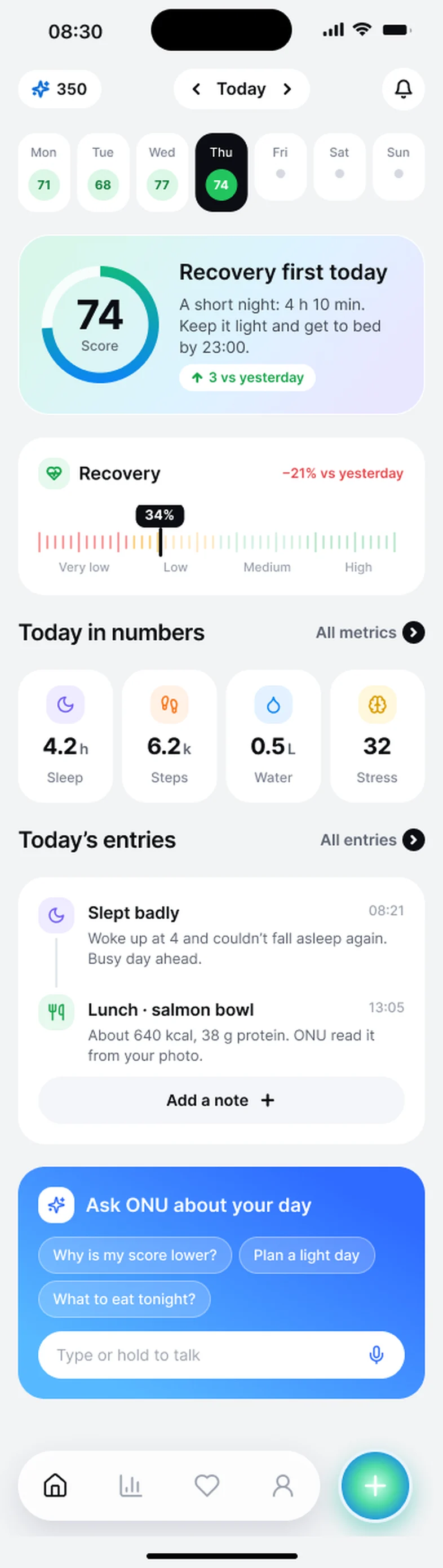
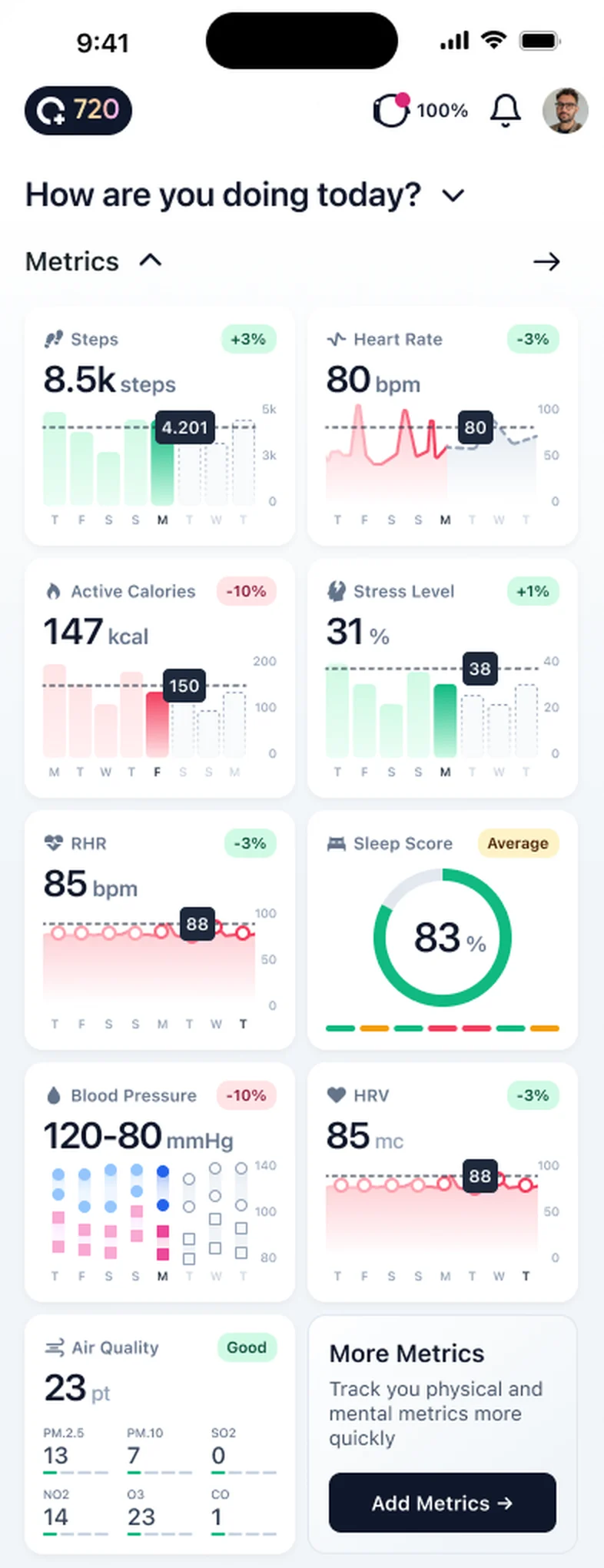
ONU does not measure cortisol and cannot tell you whether a hormone is out of range. What it can do is show your sleep, HRV, resting heart rate and activity in a daily ONU Score compared with your own baseline, with weekly and monthly trends. That can help you see whether a stressful stretch is showing up in your recovery and whether sleep has slipped.
You can also store lab reports you upload, so results from your doctor sit in one place. ONU is a wellness product, not a medical device, and does not sell lab tests or replace your clinician.
Common questions
Can I tell my cortisol is high from how I look?
No. The features people call cortisol face have many causes. Only a clinical test, interpreted by a clinician, can show your cortisol level.
Does stress cause belly fat through cortisol?
Everyday stress is not the same as the long-term high cortisol of Cushing's syndrome. Stress can affect weight through sleep, eating and activity habits. If your weight has changed, a clinician can look at the whole picture.
Is Cushing's syndrome common?
No. When it is not caused by medicines it is rare, with NIDDK estimating about 40 to 70 cases per million people. The most common cause is long-term use of steroid medicines.
Does a large waist mean I have Cushing's syndrome?
Very unlikely on its own. Weight around the middle is common and usually linked to overall weight, activity, sleep and age. It is still worth measuring, because the NHLBI links a larger waist with higher risk of heart disease and type 2 diabetes.
Should I buy a home cortisol test?
It is usually better to talk to a clinician first. Cortisol changes through the day and with stress, exercise and medicines, so results are easy to misread, and suspected Cushing's needs more than one specific test.
Can supplements lower cortisol?
Supplements are not tested to treat disease before they are sold, and claims are not checked by the FDA in advance. Talk to your doctor or pharmacist before taking any, especially if you take other medicines.
I use a steroid inhaler. Should I worry?
Talk to your doctor if you have concerns, but do not stop or change your medicine yourself. Long-term high-dose steroid tablets are the usual cause of medicine-related Cushing's syndrome.
Can low cortisol be a problem?
Yes. Low cortisol can point to adrenal insufficiency, such as Addison's disease, which needs medical care. Cortisol is not a number to push down on your own.
What to do next
Sources and further reading
- MedlinePlus: Cortisol testmedlineplus.gov
- MedlinePlus: Cushing’s syndromemedlineplus.gov
- NIDDK: Cushing's syndromeniddk.nih.gov
- NIH Office of Dietary Supplements: Dietary supplements, what you need to knowods.od.nih.gov
- CDC: About sleepcdc.gov
- NHS: Steroidsnhs.uk
- NHLBI: Assessing your weight and health risknhlbi.nih.gov
General educational information, not a diagnosis or a personal treatment plan. Device information is identified separately from independent health guidance. Speak to a qualified professional about anything that concerns you.