Key takeaways
Magnesium is an essential nutrient, and most people can get enough from food such as beans, nuts, seeds, whole grains and leafy greens. The NIH Office of Dietary Supplements does not list stress or sleep among its established uses. Ashwagandha is a plant extract with a small body of short trials, many from India, suggesting it may reduce perceived stress and help sleep a little, especially in people with insomnia.
Its long-term safety is unknown, and there are case reports of liver injury and thyroid effects. Supplements are not tested to prove they work before they are sold. Start with the cause of your stress or poor sleep, not a bottle.
Magnesium vs ashwagandha at a glance
The two are often sold side by side for stress and sleep, but they are very different products. Magnesium has an established daily requirement, a known upper limit for supplements and decades of research on deficiency. Ashwagandha has no requirement, no agreed dose and a relatively short history of modern trials.
The evidence for magnesium is mainly about getting enough for general health; the evidence for ashwagandha is mainly about stress and sleep. Magnesium's main safety issue is taking too much from supplements. Ashwagandha's are less predictable, including rare liver injury and thyroid effects.
Both can interact with medicines, but in different ways.
What magnesium is
Magnesium is a mineral your body uses for muscle and nerve function, keeping blood sugar and blood pressure in check, and making protein, bone and DNA. The NIH Office of Dietary Supplements recommends 400 to 420 milligrams a day for adult men and 310 to 320 milligrams for adult women, from all sources combined, with slightly different amounts in pregnancy. Good food sources include beans and other legumes, nuts, seeds, whole grains, leafy greens such as spinach, fortified cereals, and milk and yoghurt.
You need magnesium every day. The question is not whether you need it, but whether you need more of it from a supplement.
What ashwagandha is
Ashwagandha, Withania somnifera, is an evergreen shrub grown in parts of Asia, Africa and Europe. It is sometimes called winter cherry or Indian ginseng, although it is not related to ginseng. The NIH Office of Dietary Supplements explains that it is used in traditional Ayurvedic and Unani medicine and is often described as an adaptogen, meaning it is said to help the body cope with stress.
Most supplements use an extract of the root, and some combine root and leaf, which have different chemistry. Compounds called withanolides are thought to be responsible for many of its effects. Unlike magnesium, it is not a nutrient you need.
What the evidence shows for ashwagandha and stress
According to the NIH Office of Dietary Supplements, a 2021 systematic review of seven trials, involving 491 adults in India over six to eight weeks, found that ashwagandha reduced stress, anxiety, sleeplessness and fatigue compared with placebo. Later trials, mostly with between about 50 and 130 people over one to three months, generally reported lower perceived stress or anxiety. Not every trial agreed: one with 120 overweight adults found less fatigue but no change in perceived stress.
The doses used ranged widely, from about 120 to 1,250 milligrams of extract a day, with larger effects reported at 500 to 600 milligrams. That spread makes the right dose hard to pin down.
What the evidence shows for ashwagandha and sleep
The sleep evidence is smaller. The NIH Office of Dietary Supplements describes a 2021 analysis of five studies with 372 adults that found a small but significant improvement in sleep, larger at 600 milligrams a day and after at least eight weeks. One trial of 150 adults with sleep problems reported better sleep quality and better sleep measured by a wrist device after six weeks.
Benefits seemed larger in people with insomnia than in people who already slept reasonably well. Put simply, ashwagandha might help a little for some people with poor sleep, but it is not a proven treatment for insomnia, and the studies were short.
Ashwagandha and cortisol: what the trials measured
Ashwagandha is often sold as a way to lower cortisol, so it is worth seeing what was actually measured. The NIH Office of Dietary Supplements reports that the 2021 review of seven trials in India found lower blood cortisol with ashwagandha than with placebo, with larger effects at 500 to 600 milligrams a day. A 90-day trial of 130 adults taking 300 milligrams a day also reported lower blood cortisol.
But a 30-day trial of 60 adults in the United States found lower saliva cortisol only in the group taking 225 milligrams, not in the group taking 400 milligrams. These were short studies in healthy or stressed adults. A lower cortisol reading in a trial is not the same as treating a hormone condition, and it is not a reason to self-treat.
What the evidence shows for magnesium
The NIH consumer fact sheet covers magnesium's roles in the body and who tends to get too little. It reports that supplements may lower blood pressure, but only slightly, and that higher dietary magnesium is linked to a lower risk of some heart disease, stroke and type 2 diabetes, though other nutrients in the same foods may explain part of that. Small studies found supplements modestly reduced migraine frequency, a use the NIH says should be supervised by a clinician.
It does not list sleep or stress among magnesium's established uses. If your diet already gives you enough, more is unlikely to be the answer.
Memory, energy and fitness claims
Ashwagandha is also marketed for focus, energy, athletic performance and menopause. The evidence there is thinner. The NIH National Center for Complementary and Integrative Health says there is not enough evidence to know whether it helps athletic performance, cognitive function, diabetes, menopause symptoms or female fertility.
The NIH Office of Dietary Supplements describes a few small trials that reported better memory, focus or concentration, including one with 130 adults over 90 days and one with 54 adults over 60 days, and a 12-week trial in 120 overweight adults that found less fatigue. Small, short trials using different branded extracts are a starting point for research, not proof that a product will sharpen your thinking or boost your training.
Ashwagandha and testosterone
Some products are sold to men for testosterone or fertility. The NIH National Center for Complementary and Integrative Health describes the evidence as limited, suggesting possible increases in testosterone and sperm quality after two to four months of use. That possible hormone effect is also a safety point.
Both NCCIH and the NIH Office of Dietary Supplements note that people with hormone-sensitive prostate cancer should avoid ashwagandha, and France's food safety agency advised against use by people with hormone-related conditions. If you are trying to conceive, have a hormone-related condition or take hormone treatment, talk to your doctor before trying it, rather than relying on marketing claims.
Ashwagandha and anxiety disorders
Some people look at ashwagandha for anxiety rather than everyday stress. The NIH Office of Dietary Supplements notes that a 2022 taskforce of international psychiatry bodies gave a provisional recommendation for 300 to 600 milligrams a day of standardised root extract in generalised anxiety disorder, while stating that more research is needed for a stronger recommendation. Provisional is the key word.
Anxiety disorders have well-established treatments, including talk therapy and medicines, and a herbal extract is not a substitute for being assessed. If anxiety is affecting your daily life, see a clinician first, and if you want to try ashwagandha, discuss it with them so it fits with any other treatment.
Why the quality of the studies matters
The NIH Office of Dietary Supplements is open about the limits of the ashwagandha evidence. Preparations, standardisation and doses vary widely between studies. Some used root extracts with different branded formulas, others whole root powder or root and leaf together, and these have different chemistry.
Most trials were small and short, and many were carried out in India within traditional medicine frameworks, so it is unclear how well the results apply to a supplement bought online elsewhere. Product contents in some case reports were not verified. All of this means a product on the shelf may not match what was tested, even if the label looks similar.
Safety and side effects of magnesium
For magnesium, the NIH sets an upper limit of 350 milligrams a day from supplements and medicines for adults. Food does not count towards it. Too much from supplements can cause diarrhoea, nausea and stomach cramps, and extremely high intakes can cause an irregular heartbeat.
Magnesium is also found in some laxatives and indigestion remedies, so check labels if you take those as well. If you have a long-term health condition, including kidney disease, talk to your doctor before taking a magnesium supplement. Forms such as citrate, lactate, chloride and aspartate are absorbed more easily.
Safety and side effects of ashwagandha
The NIH Office of Dietary Supplements reports that ashwagandha appears well tolerated for up to about three months, with mild effects such as stomach upset, loose stools, nausea and drowsiness. Its safety over months to years is not known. There are case reports of liver injury, which improved after people stopped taking it, though product contents were often not verified.
Small studies show it may affect thyroid hormone levels, and a few case reports describe an overactive thyroid. It may also raise testosterone. Denmark banned ashwagandha in 2023, and France's food safety agency advised in 2024 against use in some groups, including pregnant and breastfeeding women.
Who should check first
Magnesium can stop some antibiotics and osteoporosis medicines from being absorbed properly if taken too close together, and some diuretics and long-term acid reflux medicines change magnesium levels. Ashwagandha may interact with thyroid, diabetes, blood pressure, immune-suppressing and sedative medicines. Some experts advise against ashwagandha in pregnancy, while breastfeeding, with hormone-related conditions or with hormone-sensitive prostate cancer.
If you take any regular medicine, have a thyroid, liver or kidney condition, are pregnant or breastfeeding, or are due to have surgery, ask a pharmacist or doctor before starting either. The NIH also advises telling every clinician you see about all the supplements you take.
Timing magnesium around medicines
If you take certain medicines, when you take magnesium matters. The NIH Office of Dietary Supplements explains that magnesium binds to tetracycline antibiotics such as doxycycline and quinolone antibiotics such as ciprofloxacin, so the antibiotic should be taken at least two hours before, or four to six hours after, a magnesium supplement. Bisphosphonates for osteoporosis, such as alendronate, should be kept at least two hours apart from magnesium too.
Some medicines lower magnesium over time. Long-term use of acid-reducing proton pump inhibitors, usually for more than a year, and some loop and thiazide diuretics can cause low levels. These are good reasons to let your pharmacist plan the timing with you.
Common myths about these supplements
The first myth is that natural means safe. The NIH points out that some natural products can harm the liver, and ashwagandha has case reports of exactly that. The second is that a supplement on sale has been proven to work.
In the United States, supplements do not need approval before they are sold, and claims are not checked in advance. The third is that if a little helps, more is better. Magnesium has an upper limit for a reason, and ashwagandha's benefits were not clearly larger at higher doses.
The fourth is that a supplement can make up for a sleep schedule or workload that is not working.
How to decide
Start with the reason, not the label. If you are tired or tense, a supplement treats a guess. Look at your sleep, your workload, caffeine and alcohol, and whether stress has a clear cause you can change.
If tiredness or poor sleep lasts for weeks, see a clinician, because conditions such as anaemia, thyroid problems or sleep apnoea need proper testing. If you think your diet is low in magnesium, adding magnesium-rich food is a sensible first step. If you still want to try a supplement, choose one, not both, so you can tell what made a difference, and set a time limit for trying it.
Sleep problems have better-proven first steps
If sleep is the main reason you are looking at supplements, it helps to know what the NHS recommends first. It describes insomnia as short term if it lasts under three months and long term if it lasts longer, and lists stress, anxiety, noise, caffeine, alcohol, shift work, pain and many medicines among the causes. Its self-help advice includes a fixed wake-up time, an hour to relax before bed, and avoiding caffeine, alcohol and smoking for six hours before bed.
When habits are not enough, cognitive behavioural therapy for insomnia is often offered, face to face or online. The NHS notes that pharmacy sleep remedies with natural ingredients cannot cure insomnia and may help for only a week or two.
Setting up a fair trial for yourself
If you decide to try one supplement, give it a fair test. Keep everything else as steady as you can, so you are not changing your bedtime, caffeine and exercise in the same week. Note how you sleep and feel for a week before you start, then for four to eight weeks while taking it, which matches the length of most ashwagandha trials.
Decide in advance what would count as a real improvement. If nothing changes, stop rather than adding a second product. Remember that feeling better during a quieter week may have nothing to do with the supplement, and that only a small effect was seen in trials.
Practical steps this week
Before buying anything, spend a week noting your bedtime, wake time, caffeine and alcohol, and your stress level each day. Add one or two magnesium-rich foods to your meals. Try one change that addresses the cause, such as a regular bedtime, a short daily walk or a firm finish time for work.
If you then decide to try a supplement, read the label, check the amount per serving and stay within it. Write down the product name, dose and start date, and take the list to a pharmacist to check against your medicines. Stop and get advice if you notice side effects such as yellowing skin, dark urine or a racing heart.
Who is more likely to be low in magnesium
The NIH Office of Dietary Supplements notes that many diets in the United States fall short of the recommended amount, with men over 70 and teenagers most likely to have low intakes. People with gut conditions such as Crohn's disease or coeliac disease, people with type 2 diabetes, people with long-term heavy alcohol use and older adults are more likely to get too little. Some medicines also affect magnesium levels.
Short-term low intake usually causes no obvious symptoms, because the kidneys hold on to magnesium. Long-term deficiency can cause loss of appetite, nausea, tiredness and weakness, and severe deficiency can cause muscle cramps, numbness and an abnormal heart rhythm.
Can a blood test show low magnesium?
It is harder than you might think. The NIH Office of Dietary Supplements explains that most of the body's magnesium sits inside cells or in bone, and less than 1 percent is in the blood. 75 millimoles per litre is usually counted as low, but blood levels match the body's total stores poorly.
Other methods exist, using red blood cells, urine or saliva, and none is considered fully satisfactory. Magnesium is also not part of most routine blood panels. So a normal result does not prove your intake is ideal, and a supplement is not the obvious answer to tiredness without a reason to suspect deficiency.
Food first for magnesium
Because magnesium is a nutrient, the simplest way to make sure you get enough is through what you eat. Beans, lentils, nuts, seeds, whole grains and leafy green vegetables are all good sources, and some cereals are fortified. Milk and yoghurt add some too.
A day that includes a handful of nuts, a portion of beans or lentils, whole-grain bread or oats and a serving of greens goes a long way. The NIH also notes that magnesium from food is not harmful and does not need limiting, unlike supplements. Improving your diet also brings other nutrients and fibre that a single pill does not.
Magnesium-rich foods by the numbers
Some figures make it easier to plan. The NIH Office of Dietary Supplements lists about 156 milligrams in an ounce of roasted pumpkin seeds, 111 in an ounce of chia seeds, 80 in an ounce of almonds, 78 in half a cup of boiled spinach, 74 in an ounce of cashews and 60 in half a cup of cooked black beans. Two tablespoons of peanut butter give about 49 milligrams and half a cup of brown rice about 42.
So a small handful of almonds, a portion of black beans and some spinach together come to over 200 milligrams before counting anything else you eat. The ODS also notes that refining grains removes much of their magnesium, which is one more reason to choose whole grains.
How much magnesium your body absorbs
Not all the magnesium you swallow is used. The NIH Office of Dietary Supplements says about 30 to 40 percent of magnesium from food is absorbed, and that the kidneys adjust how much they pass out in urine depending on your status. With supplements, forms that dissolve well in liquid, such as citrate, lactate, chloride and aspartate, are absorbed more completely than oxide and sulfate, although the studies behind that are small.
Labels show the amount of elemental magnesium, not the weight of the whole compound, so compare that figure when you read them. The ODS also notes that very high zinc intakes from supplements were found in one study to interfere with magnesium absorption.
Why ashwagandha labels are hard to compare
Two ashwagandha products with similar labels can contain very different things. 5 or 5 percent withanolides, the compounds thought to drive many of its effects, along with products that state an absolute amount per capsule instead. Some use root alone, others root and leaf, and one trial used whole-root granules at a much higher daily weight.
Doses in sleep trials ranged from 120 milligrams of one extract to 250 to 600 milligrams of another. The ODS notes that this variation makes it hard to identify specific extracts or recommend amounts. If you buy a product, the dose on a trial is only meaningful for the same extract, not for ashwagandha in general.
Reading a supplement label
A label can tell you what a product claims to contain, but not that it works. The NIH Office of Dietary Supplements explains that in the United States, labels may say a product supports a body function, such as sleep or stress, but must carry a statement that the claim has not been evaluated by the FDA. Look for the amount per serving and the form, such as magnesium citrate or a named root extract.
Check whether magnesium is already in a multivitamin or remedy you take, so you do not exceed the upper limit. A quality seal tells you what is in the bottle. It does not tell you the product works.
A worked example
Nadia is sleeping badly and feeling on edge during a demanding project. A friend recommends ashwagandha and another swears by magnesium. Nadia takes medicine for an underactive thyroid, so she asks her pharmacist first.
The pharmacist points out that ashwagandha may affect thyroid hormone levels and interact with her medicine, and suggests she avoid it. Magnesium supplements could interfere with some other medicines if taken at the same time, but not hers. Nadia adds nuts and beans to her meals, cuts her afternoon coffee and sets a regular bedtime.
After three weeks she sleeps better. She books a GP appointment to talk about the stress itself.
When to see a doctor
See a doctor if stress, low mood or poor sleep has lasted several weeks, affects your daily life, or comes with symptoms such as loud snoring with pauses in breathing, unexplained weight change or lasting tiredness. Stop ashwagandha and get medical advice promptly if you notice yellowing of your skin or eyes or dark urine, which can be signs of liver problems. Also seek advice if you develop a fast or irregular heartbeat, trembling, heat sensitivity or unexplained weight loss, which the NHS lists among the symptoms of an overactive thyroid. Seek urgent help for chest pain, fainting or severe breathlessness.
How ONU fits
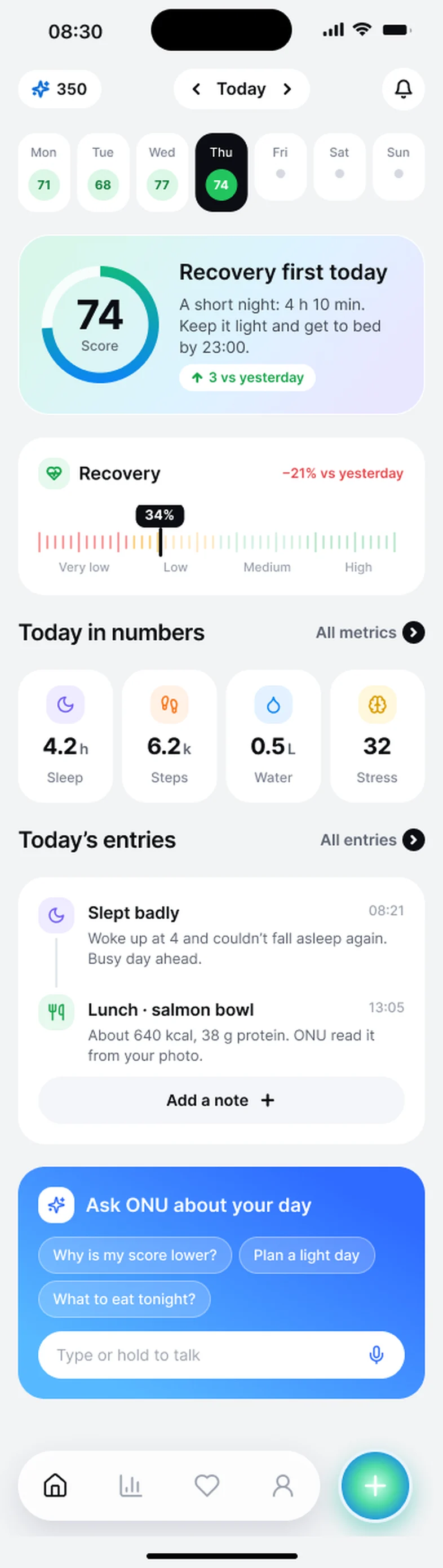
ONU does not sell or recommend supplements. It shows your sleep, recovery signals and activity in a daily ONU Score compared with your own baseline, with weekly and monthly trends, so you can see whether a change you try lines up with any difference in how you sleep and recover. It cannot tell you whether a supplement worked or is safe for you.
ONU is a wellness product, not a medical device. For questions about supplements and your medicines, your pharmacist or doctor is the right person.
Common questions
Can I take magnesium and ashwagandha together?
Ask a pharmacist first, especially if you take other medicines. Starting both at once also makes it impossible to tell which one did what.
Which is better for sleep?
Ashwagandha has a few small trials suggesting a modest benefit, mostly in people with insomnia. The NIH consumer sheet does not list sleep as an established use of magnesium. Neither is a treatment for insomnia.
Which is better for stress?
Ashwagandha has more trials on stress, though they are small and short. Magnesium is not an established treatment for stress. Neither replaces dealing with the cause of the stress.
Is ashwagandha safe long term?
Its long-term safety is not known. Studies have mostly lasted up to about three months, and there are case reports of liver injury.
Does ashwagandha lower cortisol?
Some short trials reported lower cortisol with ashwagandha than with placebo, but results were not consistent across doses. That is not the same as treating a hormone condition, and long-term effects are unknown.
Can I take too much magnesium?
From supplements, yes. The adult upper limit is 350 mg a day from supplements and medicines. Food magnesium does not count towards it.
Does ashwagandha affect the thyroid?
It may. Small studies show changes in thyroid hormone levels, and there are case reports of an overactive thyroid. Ask your doctor if you have a thyroid condition.
Should I avoid ashwagandha in pregnancy?
Some experts advise against it, and France's food safety agency recommends against use in pregnancy and breastfeeding. Talk to your doctor or midwife.
Can a blood test tell me if I need magnesium?
Only partly. Less than 1 percent of the body's magnesium is in the blood, so the NIH notes that blood levels reflect total stores poorly. Your doctor can judge whether testing makes sense for you.
What to do next
Sources and further reading
- NIH Office of Dietary Supplements: Magnesium (consumer fact sheet)ods.od.nih.gov
- NIH Office of Dietary Supplements: Ashwagandha (health professional fact sheet)ods.od.nih.gov
- NIH Office of Dietary Supplements: What you need to knowods.od.nih.gov
- NHS: Overactive thyroid (hyperthyroidism)nhs.uk
- NIH Office of Dietary Supplements: Magnesium (health professional fact sheet)ods.od.nih.gov
- NCCIH: Ashwagandha, usefulness and safetynccih.nih.gov
- NHS: Insomnianhs.uk
General educational information, not a diagnosis or a personal treatment plan. Device information is identified separately from independent health guidance. Speak to a qualified professional about anything that concerns you.