Key takeaways
A blood test report looks technical, but each line follows the same pattern: what was measured, your value, the unit and the lab's reference range. MedlinePlus explains that reference ranges come from large groups of healthy people, that they vary between labs, and that healthy people sometimes fall outside them. A result inside the range does not guarantee good health either.
Food, medicines, supplements, hard exercise, your period and skipping a fast can all shift results. Compare new results only with earlier ones from the same lab and in the same units. Ask the person who ordered the test what a flagged result means for you, and do not try to diagnose yourself from one number.
Read the whole line, not just the number
Find the four parts first: what was measured, your value, the unit, and the range printed beside it. A number without its unit can mislead you badly. Cholesterol, for example, can be reported in milligrams per decilitre or in millimoles per litre depending on where you are tested, so the same result can look completely different.
Check the unit before you compare a new report with an old one or with something you read online. Some reports also show an abbreviation instead of the full name, so look it up in the lab's key or ask.
Blood test results explained: what a reference range is
The range shows where results fall for most healthy people tested by that lab, using that lab's equipment and methods. MedlinePlus notes that ranges can differ between groups, such as children and adults, and between labs, which is why it calls the word normal potentially misleading. Being just inside or just outside the range is not automatically good or bad.
Some people sit near an edge all their lives. Equally, a result comfortably inside the range does not rule out a problem if you have symptoms. What your clinician cares about is what the result means for you, alongside everything else they know.
A reference range is not a personal target
For some tests, the range printed on the report is not the goal your clinician has in mind. Cholesterol is a good example. MedlinePlus lists general healthy levels, such as total cholesterol under 200 mg/dL and LDL under 100 mg/dL for adults, but adds that ideal numbers depend on age, blood pressure, weight, family history and other factors.
Someone with diabetes or heart disease may be given a different target. Blood sugar, kidney markers and others work the same way. Treat the range as a starting point for a conversation, and ask your clinician whether any of your numbers have a personal target.
Words you will see on a report
MedlinePlus explains a few common terms. Negative or normal means the test did not find what it was looking for, so the condition is unlikely, though more tests may still be needed. Positive or abnormal means the test found what it was looking for, and more tests may be needed to confirm a diagnosis.
Inconclusive or uncertain means the result was not clear either way, and you will probably be retested. You may also see H or L next to a value, or a symbol such as an asterisk, which simply mark results outside the range. None of these words explains why a result came out as it did.
When a result is flagged
A flag means the value is outside that lab's range. It does not tell you why, or whether it matters. MedlinePlus notes that it is common for healthy people to fall outside a range sometimes, and that false positive and false negative results, though uncommon, can happen, especially if a test was not done correctly.
If a flagged result arrives with no explanation, do not guess. Ask the person who ordered it: What does this result suggest? Could anything on the day have affected it?
Does it need repeating? What happens next, and by when? Write the answers down.
Why one result is rarely the whole story
Every blood test has some natural variation, from the day, the sample and the lab method. MedlinePlus explains that false positive results, which suggest a condition you do not have, and false negative results, which miss a condition you do have, are uncommon but possible, and that retesting may be needed. That is why clinicians often repeat a borderline result before acting on it, or look at related tests together.
A single out-of-range value with no symptoms is usually a reason to recheck, not to panic. A clear pattern across several results, or a result that matches your symptoms, carries much more weight.
When one test leads to another
It is normal for a result to lead to a second, more specific test, and it does not mean something serious has been found. MedlinePlus gives several examples. An abnormal TSH is usually followed by thyroid hormone tests, T4 and T3, and sometimes thyroid antibody tests, which can help show whether an autoimmune condition is the cause.
A low ferritin may be looked at alongside a full blood count and other iron tests. A raised glucose may be followed by a fasting test or HbA1c. Each step narrows down what the first number could mean.
If you are sent for further tests, ask what question each one is meant to answer and how long results usually take.
The complete blood count
One of the most common tests is the complete blood count, or CBC. MedlinePlus explains that it measures red blood cells, which carry oxygen; white blood cells, which fight infection; and platelets, which help blood clot. It also reports haemoglobin, the iron-rich protein that carries oxygen, haematocrit, the share of your blood made up of red cells, and the average size of red cells.
Abnormal red cell results can point to dehydration, anaemia or low iron. A high white cell count can reflect an infection or a reaction to a medicine. MedlinePlus stresses that an abnormal CBC result does not always mean you need treatment.
If you also have symptoms such as tiredness or breathlessness, the free anaemia symptoms check helps you prepare for the appointment.
The metabolic panel
Another common test is the comprehensive metabolic panel, or CMP. MedlinePlus describes it as a routine test of 14 substances, including glucose for blood sugar; sodium, potassium, chloride, bicarbonate and calcium for fluid and mineral balance; albumin and total protein; the liver enzymes ALP, ALT and AST; bilirubin; and the kidney markers BUN and creatinine. Together they give a broad picture of kidney and liver health, blood sugar and fluid balance.
An out-of-range value can signal a problem but does not confirm one. A high glucose, for example, may point towards diabetes, and your provider will usually order further tests before reaching any conclusion.
Kidney and liver markers in plain words
The kidney and liver lines on a metabolic panel cause a lot of worry, so it helps to know what they are. MedlinePlus explains that BUN and creatinine are waste products the kidneys filter out, so they give a picture of how well your kidneys are working. ALT, AST and ALP are enzymes linked to the liver, and bilirubin is a by-product of breaking down old red blood cells, which the liver processes.
Albumin and total protein reflect proteins made largely by the liver. A single value slightly outside the range is common and often explained by everyday factors. Your provider looks at the pattern across all of them.
Blood sugar on a report
Glucose is one of the most watched numbers on a report, and it is also one of the most affected by timing. A result taken after a meal is not comparable with one taken after an overnight fast, which is why your provider may ask you to avoid food for several hours before a metabolic panel. MedlinePlus notes that a high glucose may point towards diabetes, but that further testing is usually needed to confirm or rule it out.
If your report shows a raised glucose, check whether you had fasted, note any illness or new medicines, and ask whether a repeat or a different blood sugar test is planned. If diabetes runs in your family, the free type 2 diabetes risk test shows how your risk factors add up.
Cholesterol and lipid results
A lipid panel usually reports total cholesterol, LDL, HDL, non-HDL cholesterol and triglycerides. MedlinePlus describes LDL as the type that contributes most to buildup in the arteries and HDL as the type that helps carry cholesterol away. It lists triglycerides under 150 mg/dL as normal for adults, 150 to 199 as borderline and 200 or more as high, and HDL under 40 mg/dL in men or under 50 in women as low.
You may be asked to fast for 9 to 12 hours beforehand. These results are always read alongside your blood pressure, smoking, diabetes and family history, not in isolation. To go through your own numbers line by line, read cholesterol results explained.
HbA1c: blood sugar as an average
Some reports include HbA1c, shown as a percentage rather than a concentration. MedlinePlus explains that it reflects your average blood sugar over the past two to three months, by measuring how much of the haemoglobin in your red blood cells has glucose attached. That makes it less sensitive to what you ate yesterday than a single glucose reading.
5 percent or higher for diabetes, while noting that providers often use more than one test before making a diagnosis. Anaemia and other red blood cell conditions, kidney failure, liver disease, pregnancy and some medicines can affect the result, so mention any of these.
Thyroid results: why TSH comes first
If your thyroid was checked, the first line is often TSH, thyroid-stimulating hormone. MedlinePlus explains that the pituitary gland in the brain makes TSH to tell the thyroid how much hormone to produce. That is why the numbers can seem back to front.
A high TSH usually means thyroid hormone is low and the pituitary is pushing harder, a pattern that fits an underactive thyroid. A low TSH usually means thyroid hormone is high, which fits an overactive thyroid. TSH shows whether the amount is right, not what is causing a problem.
MedlinePlus adds that serious illness can lower TSH for a while, that it is often a little low early in pregnancy, and that it can run higher in people over 80 with no thyroid problem.
Iron stores and ferritin
A normal haemoglobin does not always mean your iron is fine, which is why some reports include ferritin. MedlinePlus describes ferritin as a protein that stores iron, so the test gives a picture of how much iron your body has in reserve. A low level may point to iron deficiency, and left untreated, low iron can lead to anaemia and other problems.
A high level can come from too much iron, but MedlinePlus lists many other causes, including inflammation after an infection or surgery, autoimmune conditions, liver disease, obesity, heavy alcohol use and an overactive thyroid. Certain medicines can also shift ferritin. So a high ferritin is a reason to ask what else is going on, not a sign that you have too much iron.
eGFR: the kidney number that is calculated
Many reports show an eGFR next to creatinine. MedlinePlus explains that it is an estimate of how well your kidneys filter waste, calculated by a formula that combines your creatinine result with details such as your age and sex, and sometimes a blood protein called cystatin C. As a general guide, MedlinePlus lists 90 or above as probably no kidney disease, 60 to 90 as possibly early kidney disease, 15 to 60 as possible kidney disease and below 15 as possible kidney failure, and it stresses that results should be read with a provider. Eating meat before the test, some medicines and very high or low muscle mass can all affect the estimate, so a single low reading is usually checked again.
Vitamin D: not a routine test for everyone
Vitamin D is a popular extra on online panels. MedlinePlus explains that the standard test measures 25-hydroxyvitamin D, the form made by your liver, and that providers usually order it when they suspect a deficiency, for example with bone pain, muscle weakness, fractures, low bone density, very little sun exposure, problems absorbing nutrients or certain medicines. It is also used to monitor supplements.
MedlinePlus states plainly that routine vitamin D testing is not recommended for everyone. Results are usually labelled deficient, insufficient or possibly toxic. A high level most often comes from taking too much in supplements, which can harm organs and blood vessels.
Ask whether the test answers a question about you before adding it.
Compare results without losing the context
Trends are useful, but only if you compare like with like: the same test, the same unit and, as MedlinePlus advises, ideally the same lab, because labs often use different methods and ranges. Keep the original reports, with dates. A small change between two tests can simply be normal variation.
A steady drift in one direction over several tests is more meaningful than a single jump. When you look back, note what was different each time, such as illness, a new medicine, a change in diet or a different time of day. Those notes often explain more than the numbers do.
Common mistakes when reading results
The first mistake is reading the flag and skipping the rest of the line. The second is comparing results from different labs or units as if they were the same. The third is searching each flagged value online and landing on the most alarming explanation.
The fourth is assuming a clean report means you are healthy, even if you still have symptoms. The fifth is stopping or starting medicines or supplements because of a single result. And the sixth is buying the largest possible panel in the hope of finding something.
More tests mean more chances of a borderline result that leads to worry and repeat testing without answering a real question.
How often tests are usually repeated
How often you need a given test depends on your age, your health and why it was ordered. For cholesterol, MedlinePlus gives a general schedule: adults aged 21 to 65 every five years, men aged 45 to 65 and women aged 55 to 65 every one to two years, and adults over 65 every year, with more frequent tests if you have risk factors or take medicines. Other tests may be repeated within weeks to check a borderline result, or yearly to monitor a known condition. Ask your clinician when your next test should be, and write the date down so trends are easy to follow.
Home tests and direct-to-consumer panels
Home finger-prick kits and online blood panels are widely sold. MedlinePlus advises that at-home tests should never replace tests your provider orders, that you should ask your provider or pharmacist which tests to trust, and that you should discuss results with your provider even if they look normal. A large panel without a clear reason can produce borderline results that lead to anxiety and more testing. If you do use one, keep the full report with its ranges and units, and bring it to an appointment rather than acting on it alone.
Using apps and AI to organise a report
A tool can pull the numbers out of a PDF and line them up over time. That can make trends easier to see and help you spot when units or labs changed. It cannot examine you, know your history or weigh your symptoms.
It may also get abbreviations or units wrong. Use it to tidy your records and prepare questions, not to decide what a result means. If a tool gives you an explanation that worries you, take the original report and the question to your clinician rather than acting on the summary.
Questions to ask about your results
A short list of questions makes any results conversation more useful. Which results are outside the range, and do any of them matter for me? Could anything on the day, such as food, exercise, illness or a medicine, explain them?
Do you want to repeat any tests, and when? Is there a personal target for any of my numbers that differs from the printed range? Is there anything I should change, and how will we know if it worked?
When should I be tested again? If you are given a printout, ask the clinician to mark the lines that matter most, so you know where to focus.
Practical steps before and after your next test
Before the test, ask what is being checked and why, whether you need to fast, and whether to take your usual medicines. Write down any supplements you take, because MedlinePlus advises telling your provider about all of them. Avoid hard exercise the day before unless told otherwise, and drink water if allowed.
After the test, ask how and when you will get results and who will explain them. When the report arrives, read each line in full, note any flags and list your questions. File the report with its date so you can compare like with like next time.
Why preparation and timing matter
Some tests are affected by whether you ate, the time of day, recent exercise, illness or medicines. MedlinePlus lists certain foods and drinks, medicines and supplements, hard exercise before the test, having your period and not following preparation instructions, including fasting, among the things that can change results. For a CBC, it adds not drinking enough water.
If you were asked to fast and did not, say so. If you trained hard the day before, mention it. If a result surprises you, the conditions on the day are one of the first things worth checking, and a repeat test may settle it.
What happens on the day
For most people a blood test is quick. The NHS explains that a small sample is usually taken from the inside of your elbow with a needle, sometimes from the wrist or with a finger-prick, after a band may be placed around your arm to make the vein easier to find. It typically takes about 10 minutes at a GP surgery or hospital.
You may have some bruising or swelling where the needle went in, which should fade within a few days. Before the test, ask whether you need to fast, usually with only water allowed, or pause any medicines such as blood thinners. If needles worry you, tell the staff, and you can bring someone with you.
Waiting for your results
Results do not always arrive the same way. The NHS says they often come back within a few days and usually within a few weeks, and that some surgeries only contact you if a result needs discussing. That means silence may simply mean nothing needs action, but it is worth confirming.
Ask at the time of the test how you will hear and roughly when. If you have not heard anything after a few weeks, contact the surgery or the specialist who ordered the test. The NHS also notes that you can ask a professional to explain any results you do not understand.
A worked example
Tom's routine check shows a red flag next to haemoglobin, slightly below the lab's range, and a high ALT, a liver enzyme. He starts searching and quickly finds frightening explanations. Instead he writes down the context: he had a stomach bug the week before, did a heavy gym session the day before the test and takes a new supplement.
At his follow-up, his doctor asks about diet, periods of blood loss and alcohol, and suggests repeating both tests in a few weeks without the supplement. On the repeat, ALT is back in range and haemoglobin has risen. The doctor explains what would have prompted further tests.
When to talk to a doctor
Always discuss results with the clinician who ordered the test, even if they look normal, and ask about anything flagged. Contact your doctor promptly if you are told a result is significantly abnormal, or if you have symptoms such as unusual tiredness, breathlessness, unexplained bruising or bleeding, yellowing of the skin or eyes, or unexplained weight loss, whatever the report says. Seek urgent care for severe symptoms such as chest pain, severe breathlessness, fainting or heavy bleeding.
A lab result is one piece of evidence. Your symptoms and history are the rest of the picture.
How ONU fits
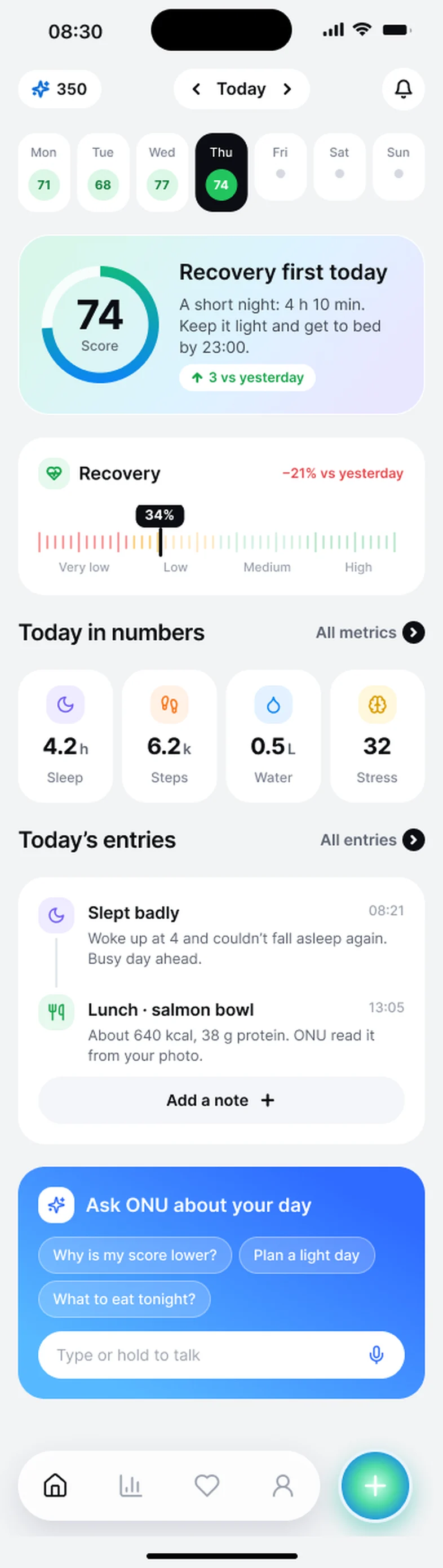
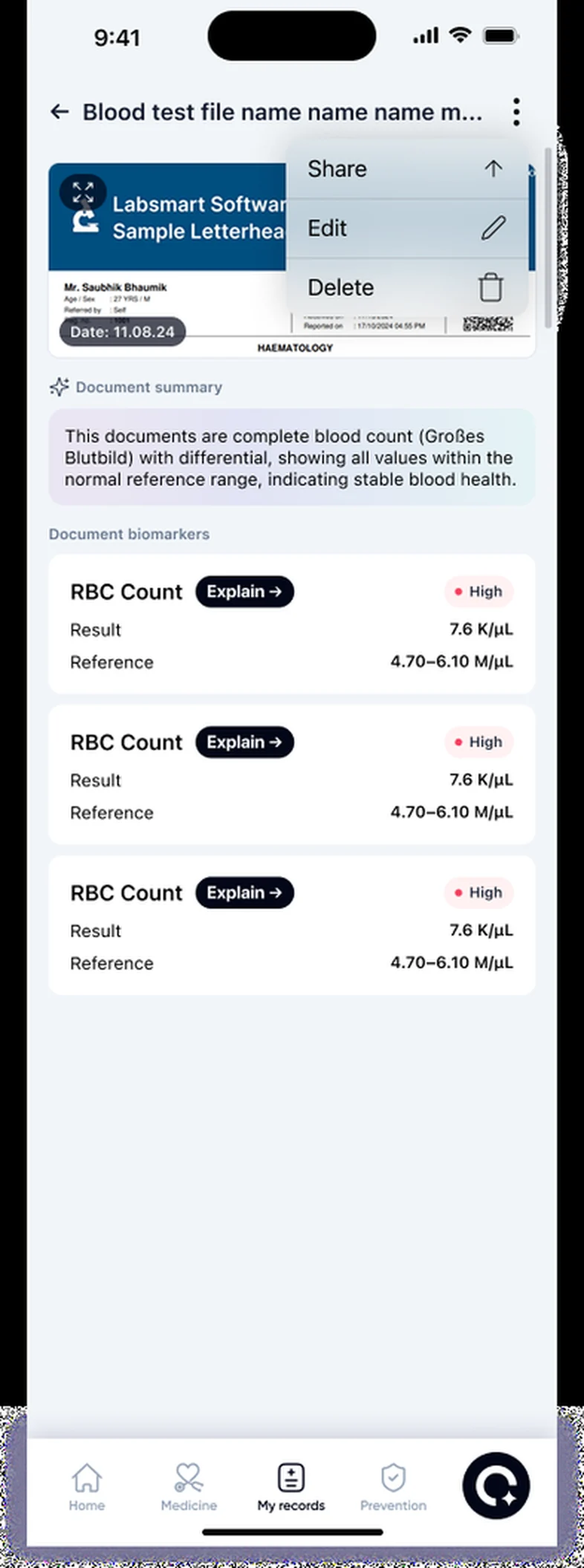
You can upload your lab reports to the ONU app, where the originals are stored alongside your daily ONU Score, sleep, recovery and activity data. When you see your doctor, your reports are in one place with their dates, which makes like-for-like comparisons easier. ONU Pro adds deeper biomarker insights and extended historical trends.
ONU does not sell lab tests, does not diagnose anything and is not a medical device. Your clinician interprets your results.
Common questions
Does a red flag mean something is seriously wrong?
Not necessarily. It means the value is outside that lab's range. MedlinePlus notes that healthy people sometimes fall outside a range. Your clinician interprets it with your history and symptoms.
Why are my results different from last time?
Normal day-to-day variation, a different lab, different units, food, medicines, supplements, exercise or illness can all change a result.
Can I compare results from two different labs?
Only with care. Labs often use different methods and ranges, so MedlinePlus advises using the same lab when tracking a result over time.
Do I need to fast before a blood test?
It depends on the test. A cholesterol test often needs 9 to 12 hours without food, and a metabolic panel may need several hours. Follow the instructions you are given.
Why is my blood sugar shown as a percentage?
That is probably HbA1c, which MedlinePlus explains reflects your average blood sugar over the past two to three months. It is reported as a percentage of haemoglobin with glucose attached, not as a concentration like a single glucose reading.
Should everyone buy the largest blood panel?
No. More tests are not automatically better. The useful tests are the ones that answer a real question about you.
What is the difference between mg/dL and mmol/L?
They are different units for the same substance. Always check the unit before comparing results with an older report or a range you found online.
Can supplements change my results?
Yes. MedlinePlus lists medicines and supplements among the things that can affect results, so tell your provider about everything you take.
Should I ask for a vitamin D test every year?
Not unless there is a reason. MedlinePlus says routine vitamin D testing is not recommended for everyone. It is mainly used when a deficiency is suspected or to monitor supplements.
What to do next
Sources and further reading
- MedlinePlus: Understanding lab resultsmedlineplus.gov
- MedlinePlus: Complete blood count (CBC)medlineplus.gov
- MedlinePlus: Comprehensive metabolic panel (CMP)medlineplus.gov
- MedlinePlus: Cholesterol levels, what you need to knowmedlineplus.gov
- MedlinePlus: Hemoglobin A1C (HbA1c) testmedlineplus.gov
- MedlinePlus: TSH (thyroid-stimulating hormone) testmedlineplus.gov
- MedlinePlus: Ferritin blood testmedlineplus.gov
- MedlinePlus: Estimated glomerular filtration rate (eGFR) and GFR testsmedlineplus.gov
- MedlinePlus: Vitamin D testmedlineplus.gov
- NHS: Blood testsnhs.uk
General educational information, not a diagnosis or a personal treatment plan. Device information is identified separately from independent health guidance. Speak to a qualified professional about anything that concerns you.