

Preventive care articles
 Written and medically reviewed by Dr. Kirill Rudinsky, Head of Research
What is usually checked at your age?
Examples from MedlinePlus for US adults. Your own programme depends on where you live and your history.
- Blood pressure at least every three to five years, more often with risk factors
- Cholesterol from age 20, every four to six years without risk factors
- Diabetes screening from 35 if overweight
 Dr. Arup Sen17 min readPreventive careBlood Test Results Explained: Ranges, Units and FlagsBlood test results explained line by line: the test name, your value, the unit, the lab’s range, and what a high or low flag does and does not mean.
 Dr. Arup Sen17 min readPreventive careBiological Age Test Accuracy: Can You Trust It?Biological age test accuracy explained: what these tests estimate, why two tests can disagree about the same person, and what is worth acting on.
 Dr. Arup Sen16 min readPreventive careMagnesium vs Ashwagandha: What the Evidence SaysMagnesium vs ashwagandha for stress and sleep: what each one is, what studies show so far, safe amounts, side effects and who should avoid them.
 Dr. Sebastian Ebert17 min read
Start here: which article answers your question
Each article starts from a real question. Pick the one closest to yours.
- I have a checkup coming and want to use it well. Read What to ask at a preventive checkup: what to bring, which screening may be due at your age, and how to leave with a plan.
- My report has H and L flags and I do not know what they mean. Read Blood test results explained: ranges, units, common panels and the questions to ask.
- A test says my body is older or younger than I am. Read Biological age test accuracy: what these clocks measure and why results move.
- I am thinking about a supplement for stress or sleep. Read Magnesium vs ashwagandha: what the evidence shows, safety and who should check first.
What these preventive care articles have in common
The best test has a clear reason behind it. Screening advice depends on your age, sex, family history and lifestyle. In the US, the Preventive Services Task Force publishes recommendations by group, and other countries run their own programmes, such as the free NHS Health Check offered every five years to many adults aged 40 to 74 in England. A bigger panel is not automatically better: borderline results can lead to more tests without answering a real question.
A number needs its context. MedlinePlus explains that reference ranges come from healthy people tested by that lab, vary between labs, and that healthy people sometimes fall outside them. Food, medicines, supplements, hard exercise and skipping a fast can all shift a result. A biological age is a model's estimate, not a direct measurement. An NIA-supported study found it rose after emergency surgery and returned to its earlier level within four to seven days.
Natural does not mean proven. The NIH Office of Dietary Supplements notes that supplements do not need FDA approval before they are sold. Magnesium is a nutrient most people can get from beans, nuts, seeds, whole grains and greens; the adult upper limit from supplements is 350 milligrams a day. Ashwagandha has small, short trials suggesting it may ease stress, but its long-term safety is unknown.
Typical screening by age, at a glance
Screening depends on where you live, your sex, your history and your risk, so treat this as a starting list for your questions, not a schedule. These examples come from MedlinePlus summaries for US adults.
| Age | Examples of what is usually checked |
|---|---|
| 18 to 39 | Blood pressure at least every three to five years, more often with risk factors; cholesterol from age 20, every four to six years without risk factors; diabetes screening from 35 if overweight |
| 40 to 64 | Blood pressure at least once a year; cholesterol every four to six years without risk factors; bowel cancer screening from 45; diabetes screening every three years from 35 if overweight |
| 65 and over | Blood pressure at least yearly; for women, a bone density scan; bowel cancer screening through 75, then a decision with your provider between 76 and 85 |
Your own programme may differ. What to ask at a preventive checkup turns these into questions, including which tests stop being useful as you get older.
Reading a lab report in four parts
Every line of a blood test report has the same four parts: what was measured, your value, the unit, and the lab's reference range. Read all four before you react to a flag.
The unit matters more than people expect. Cholesterol, for example, can be reported in milligrams per decilitre or millimoles per litre depending on where you are tested, so the same result can look completely different. The range describes most healthy people tested by that lab, and MedlinePlus notes that ranges differ between labs and groups. Sitting just outside it is not automatically a problem; sitting inside it does not rule one out if you have symptoms.
Blood test results explained goes through the common panels line by line, and the biomarker guides explain single markers such as HbA1c and ferritin.
Practical steps before your next appointment
Write a one-page summary
Medicines and supplements with doses, family history with ages at diagnosis, and the dates of your last blood pressure, cholesterol and blood sugar checks.
Ask four questions
Which screening applies to me? Why this test? What happens with the result? When should I come back?
Prepare for blood tests
Ask whether to fast and whether to take your usual medicines. Avoid hard exercise the day before unless told otherwise.
Compare like with like
Keep reports with their dates, check the units, and use the same lab where you can. Compare a biological age only with the same test, taken months apart and not just after an illness.
Test one supplement at a time
Ask a pharmacist first, stay within the label, and keep everything else steady for four to eight weeks.
Before you pay for an extra test or supplement
Preventive care is full of products sold to healthy people. A few questions sort the useful from the expensive.
- What question does it answer for me? If you cannot say, the result is unlikely to change anything.
- What exactly is measured, and how? For a biological age test, ask which sample is used, which model turns it into an age, and whether that model has been published and tested on people like you.
- What happens if it comes back abnormal? A borderline result can lead to more tests without a clear benefit.
- Can I share it with my doctor? A report your clinician can read is worth more than a score in an app.
- Is something being sold on the back of the result? Be extra careful when the main selling point is a supplement bundle. The NIH Office of Dietary Supplements notes that supplements do not need FDA approval before they are sold.
When not to wait for a checkup
A preventive checkup is for when you feel well. Book a sooner appointment for unexplained weight loss, a lump, a change in bowel habit, blood in your stool or urine, lasting tiredness or a cough that will not go away. Contact your doctor promptly if you are told a result is significantly abnormal.
Seek urgent help for chest pain, severe breathlessness, fainting, sudden weakness on one side of the body or difficulty speaking. If you take ashwagandha, stop and get advice promptly if you notice yellowing of the skin or eyes or dark urine.
Questions people ask
- How often should I have a checkup?
- The National Institute on Aging advises seeing a doctor at least once a year. Your clinician may suggest a different schedule.
- Does a red flag on my blood test mean something is wrong?
- Not necessarily. It means the value is outside that lab's range. Your clinician reads it with your history and symptoms.
- Can two biological age tests disagree?
- Yes. They use different measurements and models, so disagreement is expected. Compare results only within the same test.
- Should I buy the largest blood panel?
- No. The useful tests are the ones that answer a real question about you.
- How much magnesium do I need?
- The NIH recommends 400 to 420 mg a day for adult men and 310 to 320 mg for adult women, from food and supplements combined.
- Can a wearable replace a checkup?
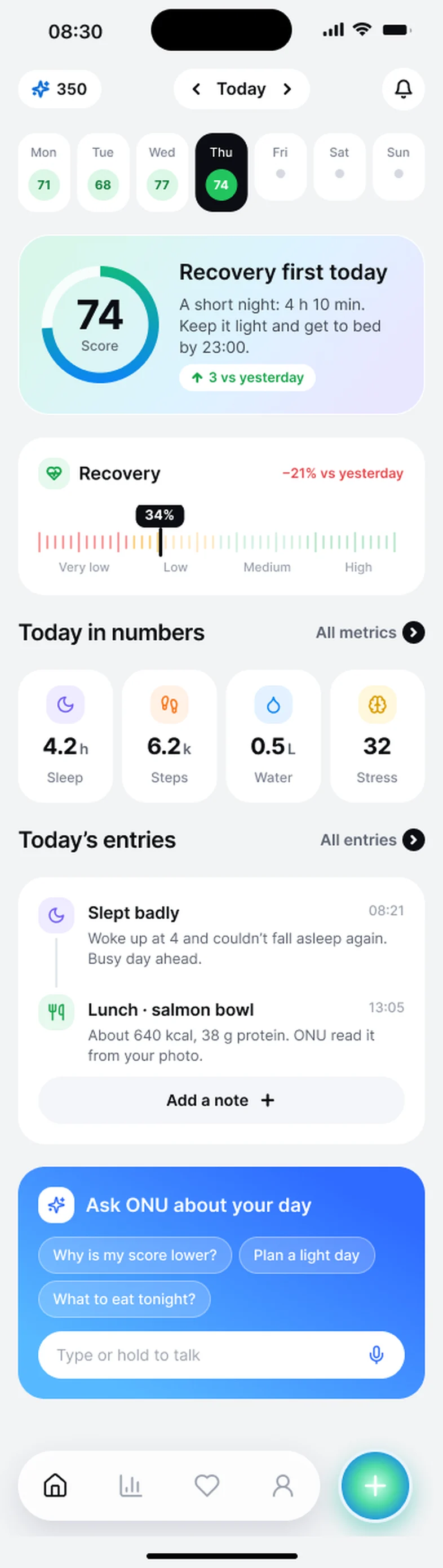
- No. It adds context about sleep, heart rate and activity, but it cannot examine you or screen for disease.
Get to know a healthier you.
Bring your everyday signals and health information into a clearer picture.